We use cookies to improve our site. By using or further navigating our site you accept our cookie policy.Please click here to check the Privacy Policy and Cookie Policy.



Smart
Empowerment

2026-09-01
 Nexlence
"I waited 12 hours, and no one could tell me what to do about my cracked screen!"
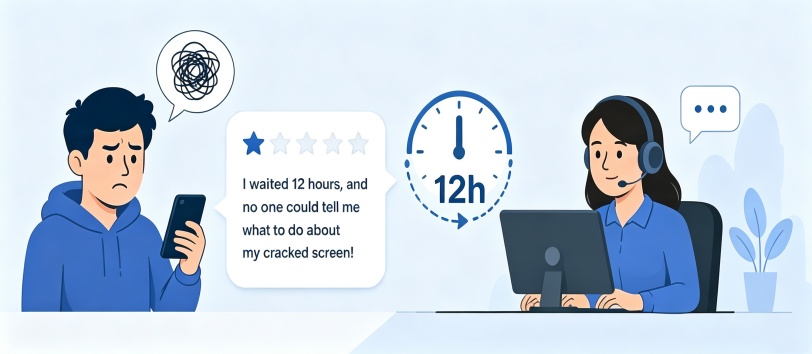
Imagine a customer buying a premium e-reader from a global consumer electronics brand. The device arrives damaged, but the customer cannot reach support until the next business day.
When an agent finally responds, the customer has to explain the situation several times before receiving a solution.
The problem is not necessarily the product. It is the customer service operation behind the product.
For consumer electronics brands expanding globally, customer interactions can happen at every stage of the customer journey—from product questions and onboarding to troubleshooting, warranty requests, repairs, and post-purchase assistance.
As customer volume increases, managing these interactions internally can become difficult.
This is where consumer electronics customer support outsourcing can help.
The goal is not simply to reduce staffing costs. A modern approach combines AI-assisted workflows with human customer service teams to provide more efficient, consistent, and scalable customer support.
Consumer electronics customer support outsourcing means working with an external CX provider to manage some or all customer service operations for consumer electronics products.
Depending on the brand's needs, this may include:
Product inquiries
Customer onboarding
Setup assistance
Usage questions
Troubleshooting conversations
Warranty support
Repair and replacement communication
RMA support
Post-sales customer service
Multilingual support
The provider becomes an extension of the brand's customer service operation rather than simply a team that answers tickets.
For consumer electronics brands, this distinction matters because customers may need assistance long after the initial purchase.
Consumer electronics products often involve multiple customer interactions throughout the product lifecycle.
A customer may ask about product features before purchasing, need help getting started after delivery, or contact support months later about a warranty or product issue.
Each interaction affects the customer's overall experience.
This makes customer service an important part of the product journey—not simply a function for handling complaints.
For global brands, the challenge becomes even greater.
Different markets require different languages, service hours, and communication approaches. Building separate customer service teams for every market can quickly increase operational complexity.
| Customer Stage | Typical Service Scenarios |
|---|---|
| Pre-Sales | Product information and feature questions |
| Onboarding | Setup and getting-started assistance |
| Product Usage | Usage and feature guidance |
| Troubleshooting | Help with common product issues |
| Warranty | Warranty questions and support |
| Repair | Repair requests and communication |
| Replacement | Replacement assistance |
| RMA | Return authorization support |
| Post-Sales | Ongoing customer care |
| Global Support | Multilingual and time-zone coverage |
The agent does not necessarily need to act as an engineer.
Their role is to understand the customer's issue, provide the appropriate assistance, follow the correct service process, and escalate when specialized support is required.
That is the core of customer service operations.
As sales increase, customer interactions increase as well.
Internal teams may eventually struggle with ticket queues, response times, staffing, training, quality monitoring, and escalations.
A CX outsourcing partner can provide additional operational capacity without requiring the brand to build a larger internal organization.
Consumer electronics brands often sell across North America, Europe, Asia-Pacific, and other markets.
Supporting these customers may require multiple languages and different service hours.
Outsourcing can provide access to multilingual customer service teams and broader time-zone coverage without creating separate internal teams for every market.
New product launches can generate a sudden increase in customer questions.
Customers may need help with product information, onboarding, setup, features, or common issues.
An outsourced CX operation can provide flexible capacity during these periods without requiring permanent internal hiring.
Customer service requires more than agents.
Managers also need to handle workforce planning, training, quality assurance, ticket queues, and performance management.
When these responsibilities become a major operational burden, outsourcing can allow internal leaders to focus on higher-value business activities.
AI can help customer service teams handle repetitive interactions and work more efficiently.
For example, AI can support:
Routine customer questions
Knowledge retrieval
Conversation summaries
Agent assistance
Customer intent identification
Self-service
Human agents remain important for complex conversations, escalations, and situations requiring judgment or empathy.
This creates a practical AI + Human customer service model.
AI improves efficiency.
Human agents maintain the personal customer experience.
The value of AI in customer service is not simply replacing agents.
It is helping agents work better.
When a customer contacts support, AI can help retrieve relevant product information or summarize previous interactions. Routine questions can also be handled through appropriate self-service options.
Human agents can then focus on conversations that require more attention.
This allows brands to combine:
AI efficiency + Human expertise + Scalable operations
For consumer electronics companies, this model can help increase support capacity while maintaining a human approach to customer service.
| Factor | In-House Support | Outsourced CX Operations |
|---|---|---|
| Staffing | Managed internally | Managed by CX partner |
| Global Coverage | Requires internal planning | Broader time-zone coverage |
| Multilingual Support | Additional hiring required | Access to multilingual teams |
| Peak Demand | Requires additional staffing | Flexible capacity |
| AI + Human Support | Internal resources required | Can be integrated into operations |
| Quality Management | Managed internally | Dedicated CX operations |
| Training | Internal responsibility | Partner-supported |
| Daily Operations | Internal management | Partner-managed |
There is no universal answer.
Some brands may keep strategic customer relationships and complex escalations in-house while outsourcing routine customer interactions, multilingual support, or selected markets.
A hybrid model can often provide a practical balance between control and scalability.
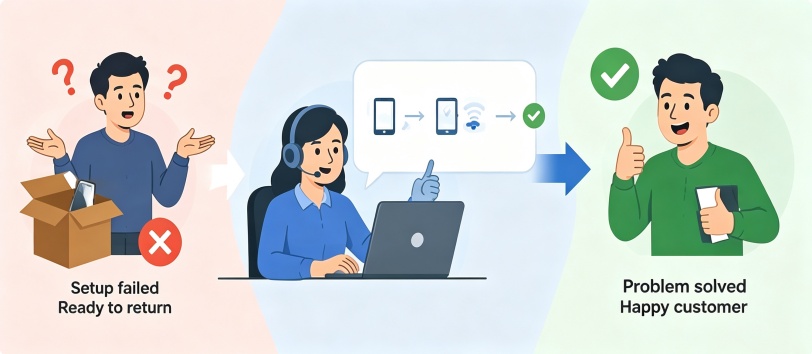
When evaluating a consumer electronics customer support outsourcing provider, look beyond cost.
Consider whether the partner offers:
AI should support customer service workflows while human agents remain available for complex interactions.
Global consumer electronics brands need customer service across languages and time zones.
Customers should be able to move between channels without repeatedly explaining the same issue.
The partner should be able to adjust capacity as customer demand changes.
Important customer service metrics include:
CSAT
First Contact Resolution
Response Time
Resolution Rate
Average Handling Time
The provider should be able to support customers beyond basic inquiries, including onboarding, troubleshooting conversations, warranty, repair, replacement, and RMA communication.
Nexlence focuses on AI + Human customer experience operations, helping brands manage customer interactions through AI-assisted workflows and human service teams.
For consumer electronics brands, this means customer service can be supported across different stages of the customer journey, including product inquiries, onboarding, troubleshooting conversations, warranty support, repair and replacement communication, and post-sales service.
Nexlence combines AI capabilities with human customer service teams.
AI can assist with routine interactions, knowledge retrieval, and agent workflows, while human agents handle customer conversations that require judgment, context, and personalized assistance.
Nexlence provides multilingual customer experience operations across international markets, helping brands scale customer service without building separate internal teams in every region.
As customer volume changes, Nexlence can help brands scale their customer service operations around business needs, including international expansion and product launches.
It is the practice of working with an external CX provider to manage customer service activities such as product inquiries, onboarding, troubleshooting conversations, warranty support, repair communication, replacement assistance, and post-sales customer care.
Not completely. AI can support routine interactions and agent workflows, while human agents remain important for complex conversations, escalations, and situations requiring judgment or empathy.
Brands may outsource to increase operational capacity, provide multilingual support, extend service coverage, manage peak demand, and access AI-assisted customer service capabilities.
Not necessarily. A hybrid model can allow internal teams to retain strategic customer relationships while an external CX partner manages scalable customer service operations.
Look for AI + Human customer service capabilities, multilingual support, scalable operations, omnichannel service, quality management, and experience with consumer electronics customer interactions.
For consumer electronics brands, customer service is part of the product experience.
Customers remember not only what they purchased, but also how the brand helped them when they needed assistance.
As customer volumes increase and brands expand globally, building every customer service capability internally can become increasingly difficult.
Consumer electronics customer support outsourcing provides another option.
By combining AI-assisted workflows, human customer service, multilingual support, and scalable operations, brands can provide consistent customer experiences without continuously expanding their internal support organization.
Nexlence combines AI + Human customer service operations to help consumer electronics brands manage customer interactions at scale.
The goal is simple: use AI to make customer service more efficient, while using human expertise to make the customer experience more valuable.











 PREVOUS ARTICLE