We use cookies to improve our site. By using or further navigating our site you accept our cookie policy.Please click here to check the Privacy Policy and Cookie Policy.



Smart
Empowerment

2026-09-02
 Nexlence

Customer experience has changed dramatically in the digital age.
In the past, customer service was mainly focused on answering phone calls, replying to emails, and resolving individual support requests. Today, customers interact with brands across websites, mobile apps, social media, online marketplaces, live chat, and other digital channels.
These interactions create a much more complex customer journey. A customer may discover a product on social media, research it on a website, make a purchase through an online store, and contact support through a messaging platform after delivery.
For businesses, the challenge is no longer simply providing customer service. The challenge is creating a consistent, connected, and personalized experience across every customer touchpoint.
This is where digital CX solutions become increasingly important.
Digital CX solutions are a combination of technologies, processes, and strategies that help businesses manage and improve customer experiences across digital channels.
Unlike traditional customer service systems that focus mainly on resolving customer issues, digital CX solutions focus on the entire customer journey — from the first interaction with a brand to post-purchase engagement and long-term loyalty.
A digital CX solution typically connects:
Customer interactions across multiple channels
Customer data and insights
Automation and artificial intelligence
Customer service operations
Analytics and performance measurement
The goal is to help businesses understand customers better, respond faster, and create more meaningful interactions throughout the customer lifecycle.
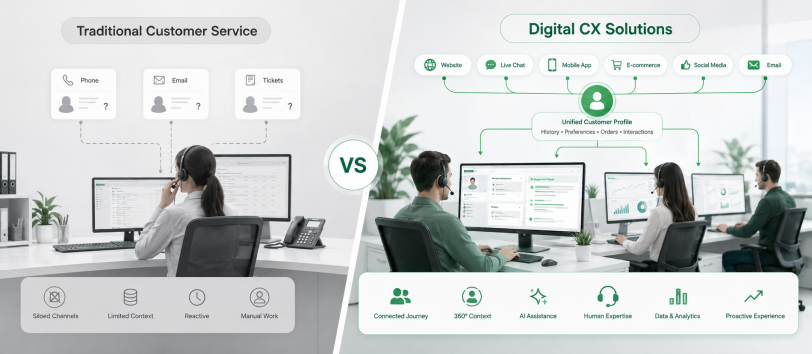
Although customer service remains an important part of customer experience, digital CX solutions take a broader approach.
| Traditional Customer Service | Digital CX Solutions |
|---|---|
| Focuses on solving customer problems | Focuses on the complete customer journey |
| Usually reactive | More proactive and predictive |
| Often managed by individual channels | Connects multiple customer touchpoints |
| Relies mainly on human agents | Combines AI, automation, and human expertise |
| Limited customer information | Uses customer data and analytics |
| Measures tickets and response times | Measures overall customer experience |
The difference is not that digital CX replaces customer service. Instead, it expands customer service into a more connected and data-driven experience.
Modern customers do not think in terms of company departments or communication channels. They simply expect brands to provide convenient and consistent support.
For example, a customer who contacts a company through social media expects the brand to understand previous conversations made through email or online chat.
Disconnected customer experiences can create frustration and reduce customer trust.
Digital CX solutions help businesses connect these interactions and create a smoother customer journey.
Brands today operate across many platforms:
Websites
Mobile applications
Social media
E-commerce platforms
Messaging channels
Customer communities
Managing these channels separately can lead to inconsistent information and inefficient operations.
Digital CX solutions help businesses bring these touchpoints together into a more unified experience.
Every customer interaction generates useful information.
Businesses can use customer data to understand:
Common customer questions
Purchasing behaviors
Customer preferences
Service challenges
Potential improvement opportunities
However, data becomes valuable only when businesses can organize and apply it effectively.
Digital CX solutions help transform customer interactions into actionable insights.
Digital CX solutions work by connecting customer interactions, technology, and business operations.
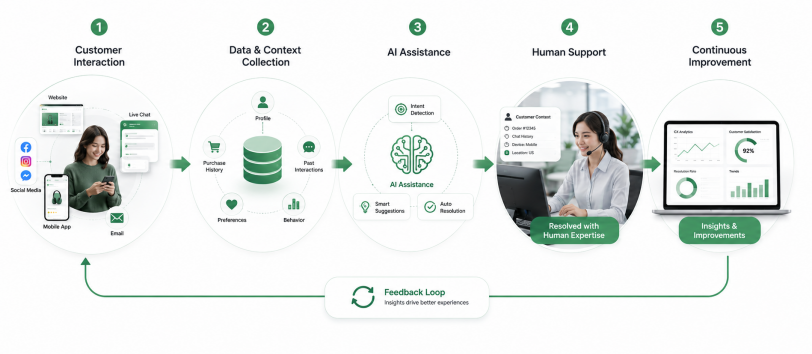
A typical customer experience process may look like this:
Customers engage with brands through different digital channels, including websites, chat platforms, social media, or mobile applications.
The system collects relevant customer information, such as previous interactions, purchase history, and service requests.
AI and automation technologies help provide faster responses, recommend relevant information, or handle repetitive requests.
Complex issues can be transferred to customer experience specialists who can provide personalized assistance.
Customer feedback and interaction data are analyzed to improve future experiences.
This creates a continuous cycle where every interaction helps businesses better understand and serve their customers.
Digital CX solutions are not built around a single technology. They combine multiple capabilities to improve customer experience.
Omnichannel technology connects customer interactions across different platforms, allowing customers to move between channels without losing context.
For example, a customer can begin a conversation through chat and continue through email without repeating the entire issue.
AI is an important component of modern digital CX solutions.
It can support customer experience through:
Automated responses
Intelligent customer routing
Customer sentiment analysis
Agent assistance
Knowledge recommendations
However, effective digital CX does not depend on automation alone. The most successful approaches combine AI efficiency with human judgment and empathy.
Analytics help businesses understand customer behavior and identify areas for improvement.
Companies can analyze customer interactions to discover:
Frequent problems
Customer satisfaction trends
Service performance
Opportunities for personalization
A strong knowledge system ensures that both customers and customer service teams can access accurate and consistent information.
This improves response quality and reduces resolution time.
One common misunderstanding is that digital CX means adding a chatbot to a website.
In reality, AI chatbots are only one part of a broader digital CX strategy.
A complete digital CX approach also includes customer data, omnichannel engagement, analytics, automation, and human support.
Digital CX solutions are not designed to remove human interaction completely.
While AI can handle repetitive tasks and provide faster responses, human expertise remains essential for complex questions, emotional situations, and relationship-building.
The future of customer experience is more likely to be a collaboration between humans and intelligent technologies.
Although large global companies often adopt digital CX solutions first, businesses of different sizes can benefit from improving customer journeys, automating processes, and creating more consistent customer interactions.
The right approach depends on business goals, customer needs, and operational requirements.
Companies looking to improve their customer experience can start with several key steps:
Identify how customers discover, purchase, use, and receive support for products or services.
Find where customers experience delays, repeated questions, or inconsistent information.
Create a clearer view of customer interactions across different channels.
Automate repetitive processes while maintaining human support for complex situations.
Use customer feedback and performance data to continuously optimize experiences.
Digital CX transformation is not a single technology implementation. It is an ongoing process of improving how businesses interact with customers.
Building an effective digital CX strategy requires more than technology alone. Businesses also need operational expertise, customer understanding, and the ability to manage experiences across different markets.
Nexlence helps businesses improve customer experiences by combining digital CX technologies with global customer experience operations.
Its approach integrates:
AI-powered CX solutions
Omnichannel customer engagement
Human-AI collaboration
Multilingual customer support
Customer experience optimization
By combining intelligent automation with experienced CX teams, Nexlence helps businesses create customer experiences that are more connected, scalable, and responsive.
Digital CX solutions combine technology, customer data, automation, and service operations to help businesses improve customer interactions across digital channels.
No. Customer service software mainly focuses on managing support requests, while digital CX solutions focus on improving the entire customer journey across multiple touchpoints.
AI helps digital CX by automating repetitive tasks, assisting customer service teams, analyzing customer interactions, and enabling faster responses.
Digital CX solutions help global businesses manage customer interactions across languages, regions, and channels while maintaining consistent service quality.
Digital CX solutions represent a shift from traditional customer service toward a more connected and customer-focused approach.
By combining omnichannel experiences, customer data, AI, automation, analytics, and human expertise, businesses can create more efficient operations while delivering better experiences.
As customer expectations continue to evolve, digital CX solutions will become an increasingly important part of how brands build stronger relationships with customers.













 PREVOUS ARTICLE