We use cookies to improve our site. By using or further navigating our site you accept our cookie policy.Please click here to check the Privacy Policy and Cookie Policy.



Smart
Empowerment

2026-09-02
 Nexlence

Growth is great—until your customer support buckles under the weight.
As your brand gains traction, the volume and complexity of customer interactions multiply. Suddenly, you are not just answering emails; you are juggling live chats, phone calls, social media comments, and DMs. Each channel is a touchpoint, and every touchpoint is an opportunity to either win or lose a customer.
Today's customers do not think in terms of channels. They expect to start a conversation on Instagram and finish it via email without repeating themselves. This shift demands more than just multichannel availability—it calls for true omnichannel customer support: unified, responsive, and brand-aligned across every platform.
Scaling omnichannel customer support effectively requires more than adding headcount. It demands a strategy that combines the right technology, skilled talent, and a deep understanding of customer experience. Done right, this approach transforms customer service from a growing challenge into a powerful driver of loyalty and business growth.
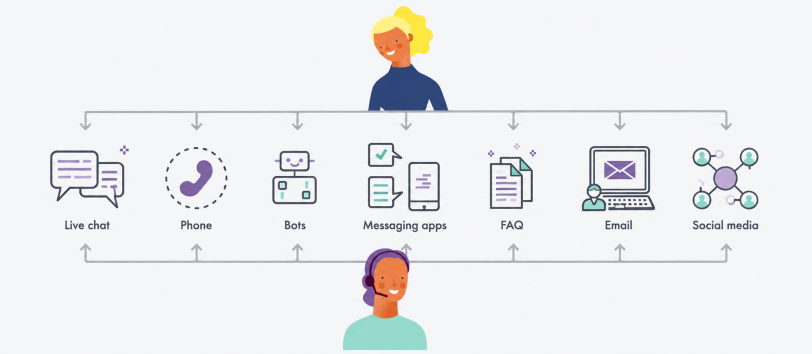
True omnichannel support is not just being present on multiple platforms—it is about delivering continuity across every customer interaction.
A scalable support system ensures that no matter where a customer reaches out—Instagram, live chat, email, or voice support—they receive the same quality of service with full context preserved.
The fundamental difference comes down to this:
Multichannel support means being present on several channels, but each channel operates independently.
Omnichannel support connects those channels so customers can move between platforms without losing conversation history or repeating their information.
At scale, the difference is significant.
A customer who starts a conversation about a billing issue through chat and follows up via email should not need to explain the same problem twice. A connected omnichannel support system gives agents access to relevant customer context, enabling faster and more personalized resolutions.
Omnichannel support is no longer just a competitive advantage. For many modern businesses, it has become an essential part of delivering a consistent customer experience.
Many companies attempt to scale customer support by simply adding more agents, more channels, or more tools.
However, growth can quickly expose weaknesses in existing support operations.
A company may have strong individual channels but still struggle with:
Technology alone cannot solve these problems.
AI deployed on top of fragmented data can create inaccurate responses. Automation without proper escalation paths can frustrate customers who need human assistance. Customer support systems without updated knowledge resources can provide inconsistent information.
Successful omnichannel support depends on combining technology, processes, and human expertise.
Adding new communication channels without connecting them creates additional complexity.
Every new channel increases the risk that customer conversations become fragmented.
For example, a customer may contact a brand through social media, then switch to email or live chat. If those interactions are stored separately, agents may not understand the full customer history.
A scalable omnichannel strategy requires connected systems that allow customer conversations to continue seamlessly across different touchpoints.
One common mistake businesses make is optimizing individual channel performance instead of measuring the complete customer experience.
Improving one channel metric does not always mean improving customer satisfaction.
For example, reducing phone handling time by transferring complex issues to email may improve one metric while creating a worse customer experience overall.
Effective omnichannel support focuses on customer-level outcomes, including:
The goal is not just faster responses. It is better customer experiences.
Scaling omnichannel customer support requires more than adding communication channels or increasing team size.
A successful support operation combines:
The goal is to create a support system that becomes more efficient as customer demand grows.
One of the biggest challenges in omnichannel support is fragmented customer information.
When customer data is separated across different systems, agents may lack important context and customers may need to repeat their issues multiple times.
A connected CX environment allows businesses to understand:
With a unified customer view, support teams can deliver faster and more personalized experiences regardless of the channel customers choose.
For global brands, this consistency is especially important because customers expect the same service quality across different markets and communication platforms.
AI has become an important capability for businesses looking to improve customer support efficiency.
However, successful AI adoption is not about replacing human agents. It is about helping customer experience teams work more effectively.
AI-powered support solutions can assist with repetitive inquiries, including:
By handling routine interactions, AI allows customer service teams to focus on more complex issues that require human judgment.
AI can also support customer service teams by:
Instead of starting every conversation from zero, agents can access customer context and provide more informed support.
When AI is connected with business knowledge and customer information, companies can provide more consistent responses across different channels.
The most effective omnichannel strategies combine AI efficiency with human expertise to create balanced customer experiences.
Technology plays an important role in scaling support, but human expertise remains essential.
Customers often need human assistance when dealing with:
These situations require empathy, problem-solving ability, and a deeper understanding of customer needs.
As businesses expand globally, customer support teams also need cultural awareness and language capabilities to provide effective service across different markets.
This is why many companies are moving toward a human-AI collaboration model.
AI improves speed and efficiency, while experienced CX professionals provide judgment, empathy, and personalized support.
Before implementing new technology, businesses should understand how customers interact with their brand.
This includes identifying:
A scalable support operation requires customer information to be available across different channels.
Integration with CRM systems, eCommerce platforms, knowledge bases, and support tools helps teams deliver more accurate and personalized responses.
Not every customer interaction should be automated.
Businesses should determine:
Successful omnichannel support should be measured through customer experience outcomes, including:
The goal is not simply improving operational efficiency. It is creating stronger customer relationships.
To evaluate omnichannel success, businesses should focus on customer-level performance rather than individual channel statistics.
Measures whether customer issues are resolved effectively without unnecessary follow-ups across multiple channels.
Shows how customers evaluate their support experience.
Measures how efficiently customer issues are addressed.
Identifies whether customers need to contact support multiple times for the same issue.
Shows whether customer support contributes to long-term loyalty.
| Challenge | Business Impact | Solution |
|---|---|---|
| Disconnected customer data | Agents lack customer context | Build a unified customer view |
| Increasing support volume | Teams struggle to maintain quality | Combine automation with scalable CX operations |
| Inconsistent information | Customers receive different answers | Create centralized knowledge management |
| Global support complexity | Difficult to maintain consistent service across markets | Build multilingual CX capabilities |
| Over-automation | Complex issues lack human attention | Combine AI with experienced CX teams |

Scaling customer support successfully requires more than technology.
Businesses need a partner that understands customer experience operations, digital transformation, and global service delivery.
Nexlence helps brands build scalable omnichannel customer support operations by combining:
By combining intelligent automation with experienced CX professionals, Nexlence helps businesses manage increasing customer demands while maintaining personalized and consistent experiences.
For global brands, this approach provides the flexibility and expertise needed to transform customer support from an operational challenge into a competitive advantage.
Omnichannel customer support connects multiple communication channels into one integrated customer experience, allowing customers and agents to continue conversations without losing context.
AI helps automate repetitive interactions, assist customer service teams, analyze customer information, and improve response efficiency across multiple channels.
Multichannel support provides customers with multiple communication options, while omnichannel support connects these channels into a unified customer experience.
Yes. Many global companies work with CX outsourcing partners to combine technology, skilled customer service teams, and operational expertise to scale support efficiently.
Scaling omnichannel customer support is not simply about managing more conversations.
It requires a strategic combination of technology, customer data, automation, and human expertise.
Businesses that successfully build scalable omnichannel support operations can deliver faster responses, create more personalized experiences, and strengthen long-term customer relationships.
For companies expanding globally, working with an experienced CX partner like Nexlence provides the operational expertise and technology capabilities needed to support growth while maintaining customer experience quality.













 PREVOUS ARTICLE