We use cookies to improve our site. By using or further navigating our site you accept our cookie policy.Please click here to check the Privacy Policy and Cookie Policy.



Smart
Empowerment

2026-09-01
 Nexlence
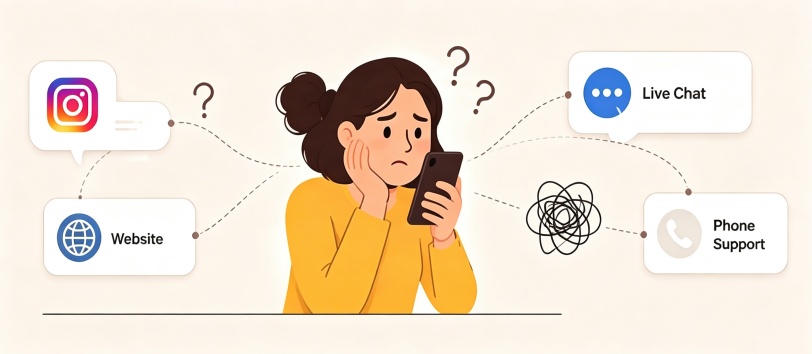
Imagine a customer who discovers your product on Instagram, visits your website to learn more, contacts customer service through live chat, and later calls your support team about an order.
From the customer's perspective, these are not four separate interactions. They are simply different steps in one relationship with your brand.
But what happens if your social media team cannot see the website inquiry? What if the live chat agent does not know about the previous conversation? And what if the customer has to explain the same problem again when calling support?
The problem is not a lack of communication channels. The problem is that those channels are operating as separate experiences.
This is where omnichannel customer experience solutions become increasingly important. Instead of simply offering more ways for customers to contact a company, an omnichannel approach connects interactions, customer context, service operations, and data across the entire customer journey.
For growing and global brands, that connection can make the difference between a fragmented service experience and a relationship that feels consistent, responsive, and personalized.
Omnichannel customer experience solutions are designed to connect customer interactions across multiple touchpoints so that the experience remains consistent as customers move between channels.
These channels may include:
The important distinction is that omnichannel does not simply mean "being available everywhere."
A brand can have phone, email, chat, and social media support and still deliver a fragmented customer experience if these channels operate independently.
A true omnichannel model connects the customer journey across touchpoints. Customer information, interaction history, service progress, and relevant business context can follow the customer instead of remaining locked inside individual channels.
For customers, this means they can move from one channel to another without constantly starting over.
For businesses, it creates a more complete view of customer behavior and service performance.
Customers rarely think about which internal department or channel owns their problem.
They simply expect the company to know what has already happened.
For example, a customer may:
1. Ask a question through social media.
2. Visit the website and place an order.
3. Contact live chat about delivery.
4. Call customer service after the package is delayed.
5. Request a return through email.
If every interaction is stored separately, the customer may have to repeat information several times.
That creates friction at multiple levels.
Repeating the same information makes customers feel that the company is not listening.
Agents may spend valuable time searching through systems, asking customers for information they have already provided, or transferring cases between teams.
When customer information is scattered across different systems, it becomes harder to understand the complete customer journey.
Different teams may provide different answers, tones, or resolutions to the same customer issue.
This is particularly challenging for companies operating across countries, languages, and time zones.
Choosing an omnichannel solution should not begin with a list of channels.
Instead, businesses should start by asking a more important question:
Can we create one connected customer journey across those channels?
Several capabilities are especially important.
Customer conversations should not exist as isolated tickets.
When a customer moves from chat to voice or from social media to email, the relevant interaction history should remain accessible to the service team.
This allows agents to continue the conversation instead of restarting it.
Customers should receive a consistent level of service regardless of where they contact the brand.
This includes:
Consistency becomes even more important for global businesses serving customers in different markets.
AI can help businesses manage repetitive customer requests while allowing human agents to focus on situations that require judgment, empathy, or complex problem-solving.
For example, AI can assist with routine inquiries, knowledge recommendations, workflow automation, quality monitoring, and customer interaction analysis.
The goal is not simply to replace human support.
The greater opportunity is to combine AI efficiency with human expertise.
Nexlence's CX model is built around this combination, using AI-powered agents, intelligent workflows, knowledge management, and human expertise to support complex customer interactions.
Global customer experience cannot rely on translation alone.
Customers expect support that understands local language, communication habits, cultural expectations, and time zones.
An effective global CX operation therefore needs both scale and local relevance.
Nexlence's global service model combines multilingual customer contact services with localized delivery, supporting voice, chat, social media, and other channels across markets.
The customer experience should not end when a support ticket is closed.
Customer interactions can provide valuable signals about product problems, customer expectations, operational inefficiencies, and opportunities for retention.
This makes CX data useful not only for customer service teams, but also for broader business decisions.
One of the biggest challenges of omnichannel customer experience is scale.
Adding more channels can increase customer reach, but it can also increase operational complexity.
AI can help address this problem by supporting both front-line interactions and back-end operations.
For example, AI can help with:
Nexlence's X-Force platform is designed around journey continuity, governed AI, and operational compounding. It connects fragmented service interactions, supports controlled AI execution, and feeds interaction signals back into knowledge, journeys, and operations for continuous improvement.
This approach moves omnichannel CX beyond simply connecting communication channels.
The objective is to create an intelligent operating model that becomes more effective as customer interactions accumulate.
The requirements of an omnichannel customer experience strategy can vary significantly by industry.
E-commerce brands may need to connect pre-sales questions, order inquiries, delivery issues, disputes, returns, and post-purchase support.
The goal is to create continuity from product discovery through post-purchase service.
Nexlence supports multilingual CX operations for cross-border e-commerce, including inquiries, disputes, and complaints across multiple regions and languages.
Consumer brands increasingly need to connect digital engagement, customer support, membership interactions, and behavioral insights.
An integrated approach can help brands deliver more personalized customer journeys while strengthening retention.
Nexlence's consumer goods solutions include omnichannel lifecycle operations, AI-driven engagement, behavioral insights, segmentation, and personalized outreach across digital touchpoints.
For smart hardware, customer support can become more complicated because customers may need help with installation, configuration, troubleshooting, repairs, or product usage.
Nexlence provides multilingual support for complex smart hardware and focuses on technical CX across installation, configuration, and repair scenarios.
Digital platforms often manage large volumes of user interactions while also dealing with content safety, moderation, complaints, and customer service.
This requires a combination of automation, operational scale, human judgment, and localized support.
Nexlence's website highlights several customer examples that demonstrate how an integrated CX model can support global operations.
For a leading global short-video social platform, Nexlence built a multilingual moderation, customer service, and operations system across Southeast Asia, Latin America, the Middle East, and other markets.
According to the published case results, the operation achieved 99.5% content review accuracy, expanded coverage across 15+ countries, and reduced the user complaint rate by 40%.
The example illustrates an important point: customer experience is not limited to answering support tickets.
For global digital platforms, CX can involve moderation, customer service, operational processes, localization, compliance, and user satisfaction at the same time.
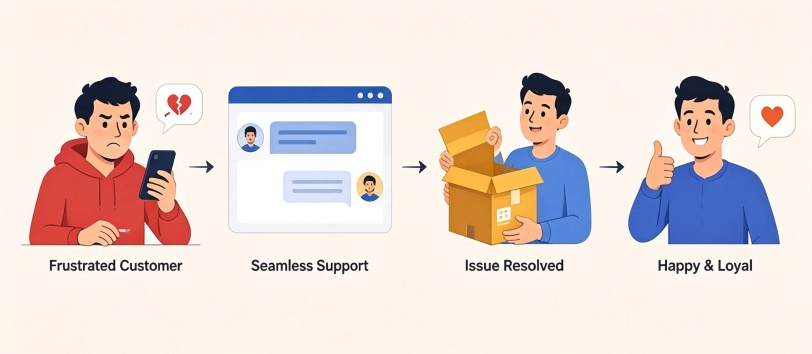
Technology alone does not guarantee a better customer experience.
When evaluating omnichannel customer experience solutions, businesses should consider the operational capabilities behind the technology.
Ask potential partners:
Look beyond basic phone and email support. Consider whether the provider can manage voice, chat, social media, messaging, and other customer touchpoints.
If your business operates internationally, evaluate language coverage, local expertise, time-zone coverage, and regional delivery capabilities.
AI should improve speed and consistency without removing human judgment from complex or sensitive customer interactions.
Your CX model should be able to support new markets, higher interaction volumes, additional channels, and changing customer expectations.
A strong CX partner should help transform customer interactions into actionable information that can improve operations and customer journeys.
Multichannel means a business offers several communication channels, such as phone, email, chat, and social media. Omnichannel connects those channels so customer information and interaction context can move with the customer across the journey.
Global customers often interact with brands through different channels and in different languages. A connected CX model helps businesses maintain service consistency while providing localized support across markets and time zones.
Not necessarily. AI is particularly useful for repetitive inquiries, workflow automation, knowledge assistance, and quality monitoring. Human agents remain important for complex, emotional, or judgment-based interactions. A combination of AI and human expertise can provide a more balanced CX model.
Businesses should evaluate channel coverage, multilingual capabilities, global delivery, AI capabilities, industry expertise, scalability, quality management, and the provider's ability to turn customer interaction data into actionable insights.
No. Omnichannel CX can cover the broader customer journey, including marketing engagement, product discovery, sales, customer service, post-purchase support, retention, and feedback.
Customers do not experience a brand one channel at a time.
They experience the brand as a whole.
That is why simply adding more support channels is no longer enough. Businesses need to connect customer interactions, operational processes, data, AI, and human expertise so that every touchpoint contributes to one continuous customer journey.
The right omnichannel customer experience solutions can help brands reduce channel friction, improve service consistency, scale customer operations, and create more meaningful relationships with customers.
Nexlence brings these elements together through AI-powered CX operations, global delivery capabilities, multilingual support, industry expertise, and intelligent platforms such as X-Force. The goal is not simply to answer more customer inquiries. It is to help brands build a CX operation that is more connected, scalable, measurable, and capable of continuously improving.
If your customers are moving between chat, voice, social media, e-commerce, and other touchpoints without a consistent experience, the next step should not simply be adding another channel. It should be understanding where the journey breaks—and building an operating model that connects those gaps.
Nexlence can help you assess those CX gaps, identify where AI and human expertise can create the greatest impact, and design a customer experience operation aligned with your markets, customers, and growth goals. Start the conversation with your current CX challenges and explore what a more connected customer journey could look like for your business.












 PREVOUS ARTICLE