Quick Answer
Human in the loop (HITL) is an approach to AI in which people are deliberately involved in preparing training data, reviewing outputs, and handling edge cases, rather than letting a model run unsupervised. It matters because AI lacks cultural context, cannot be held accountable, and cannot reliably detect its own drift. Done well, HITL pairs machine speed with human judgment, and it is increasingly expected under regulations such as the EU AI Act.
Artificial intelligence now writes text, answers customers, screens content, and flags risk at a scale no team could match manually. Yet the more widely AI is deployed, the clearer one thing becomes: speed and fluency are not the same as judgment. Models make confident mistakes, miss cultural context, and drift as the world changes around them. The organizations getting the most value from AI are not the ones that remove people from the process. They are the ones that decide, deliberately, where people belong.
This article explains what this approach means, why it remains essential, and how to design it so it works in practice.
What Is Human in the Loop?
HITL is a design approach in which people take part in an AI system's lifecycle at the points where judgment, context, or accountability matter most. Instead of letting a model run fully unsupervised, HITL builds structured human involvement into the workflow. That involvement typically happens at three stages:
1. Training and data preparation. People label, annotate, and validate the data models learn from. Poor labels produce poor models, so quality here shapes everything downstream.
2. Review and escalation during operation. AI handles routine, high-volume work. Cases that are low-confidence, high-risk, or ambiguous are routed to trained reviewers before any action is taken.
3. Feedback and continuous improvement. Reviewer decisions flow back into the system, so real-world edge cases improve the model over time.
The purpose is not to slow AI down. It is to direct scarce human attention to the moments where it changes the outcome.
Why the Future of AI Still Needs Human Intelligence

Four gaps explain why human intelligence remains part of any serious AI deployment.
Context and culture. A phrase that is harmless slang in one market can be offensive in another. Sarcasm, regional dialects, and fast-changing online language regularly defeat automated classification. Reviewers who understand the local language and culture catch what a model trained on averaged data misses.
Accountability. A model cannot be held responsible for a decision, but the organization that deployed it can. Regulation reflects this. Article 14 of the EU AI Act requires that high-risk AI systems be designed so that natural persons can effectively oversee them while they are in use, with the aim of reducing risks to health, safety, and fundamental rights. HITL is one of the most practical ways to meet that expectation.
Edge cases and drift. Policies change, products evolve, and language shifts. A model trained on last year's data can produce answers that sound plausible but are outdated. Human reviewers notice when outputs no longer match reality and turn those cases into training signal.
Trust. Customers, creators, and regulators are more willing to accept automation when they know a competent person can step in if it fails. A well-designed escalation path is part of the product experience, not a fallback.
Presence Is Not Oversight
Simply having a person somewhere in the process does not deliver these benefits. Practitioners warn about automation bias, where reviewers approve whatever the machine suggests without real scrutiny. The standard is oversight that is real, operational, and capable of making a difference, not oversight that exists only nominally. Reviewers need training, usable tools, clear criteria, and genuine authority to override the system. Without those, the loop exists only on paper.
Where HITL Delivers the Most Value
| Use case | What AI does well | What humans add |
|---|
| Content moderation | Screens large volumes of video, audio, images, and text | Judges intent, cultural nuance, and local regulation on borderline content |
| Customer support | Resolves routine, repetitive inquiries instantly | Handles disputes, complaints, and emotionally sensitive or complex exceptions |
| Data annotation and model training | Scales labeling once guidelines are stable | Defines guidelines, resolves ambiguity, and audits label quality |
| High-stakes decisions (finance, healthcare, hiring) | Surfaces patterns and recommendations | Owns the final decision and can be held accountable for it |
How to Design an Effective Human in the Loop Workflow
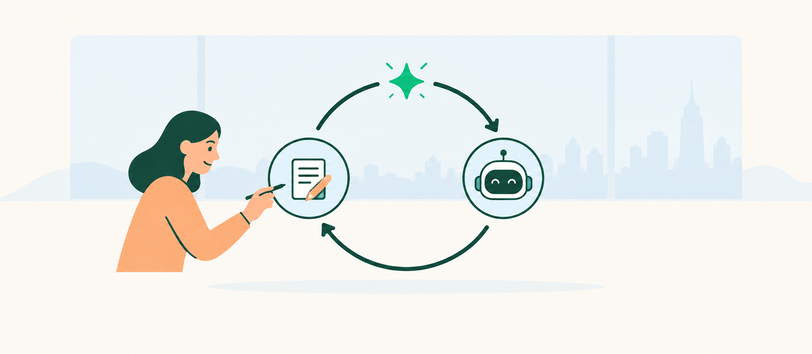
A workflow that works usually rests on a few principles:
Set confidence thresholds. Let AI act on its own only above a defined confidence level, and route everything else to a person.
Route by risk, not just volume. A refund dispute or a possible policy violation deserves human review even when the model seems sure.
Close the feedback loop. Capture every human correction and use it to retrain and refine the system.
Invest in reviewers. Train them on policy, culture, and the model's known weaknesses, and give them authority to override.
Localize. Match reviewers to the languages, cultures, and regulations of the markets you serve.
Measure both sides. Track model accuracy, reviewer accuracy, escalation rates, resolution time, and customer satisfaction together, so you can see whether the loop is actually improving results.
How Nexlence Supports Human-Centered AI Operations
Building this kind of workflow requires two things at once: AI capability and a trained, multilingual workforce. Nexlence is a global AI-driven customer experience (CX) partner that brings both. It works with 5,000+ professionals across 20+ delivery centers, with multilingual coverage including English, Spanish, Portuguese, and Russian. For teams designing their own HITL model, the relevant strengths are:
AI plus expert human review. Nexlence combines AI-assisted screening with expert human review to improve moderation accuracy and manage high-risk content, in line with local cultural and regulatory expectations. Coverage is 24/7 across short videos, live streams, audio, images, text, and comments in regional languages.
Data labeling and model training. Nexlence offers multilingual data labeling, AI model training, and localized review operations, which covers the first stage of the loop, where data quality is set.
Automation for volume, specialists for complexity. In customer support, AI-assisted automation handles high-volume cases while specialists resolve the complex ones, with 24/7 multilingual coverage.
Consistency across markets. Unified global CX standards and localized teams in 20+ delivery centers keep service on-brand while respecting regional languages and cultures.
Related guide:AI Driven Customer Experiences: How AI Is Transforming the Future of Customer Experience
Frequently Asked Questions
What does HITL stand for?
HITL is short for the phrase in this article's title. It describes AI systems in which people are deliberately involved in training, reviewing, or approving the system's outputs.
Is HITL the same as human oversight?
They overlap but are not identical. Human oversight is the broader principle, and it is what regulations such as the EU AI Act require for high-risk systems. HITL is one practical way to deliver it, by placing people inside the workflow.
Does HITL make AI slower or more expensive?
Not when it is designed well. Confidence thresholds and risk-based routing keep humans focused on the small share of cases that need judgment, while routine work stays automated. Skipping review often costs more in the long run, through errors, complaints, compliance exposure, and lost trust.
Which industries need HITL most?
Any industry where mistakes are costly or context-dependent. Common examples are social and video platforms (content moderation), e-commerce and consumer brands (multilingual support and dispute handling), and regulated sectors such as finance, healthcare, and hiring.
How do I know whether my HITL process is working?
Check whether reviewers have the training, tools, and authority to override the AI. Then track accuracy, escalation rates, resolution times, and customer satisfaction. If reviewers approve nearly everything the model suggests, that may signal automation bias rather than a healthy loop.
Do I need to build the reviewer team myself?
Not necessarily. Many organizations partner with a specialist that already has trained, multilingual teams and AI tooling, which is faster than hiring and training a global review workforce from scratch.
Conclusion
AI will keep getting more capable, but capability is not accountability. The most reliable systems are not the ones that remove people. They are the ones that use people well: to prepare good data, to review the hard cases, and to feed what they learn back into the model. Human in the loop is how organizations combine machine speed with human judgment, cultural fluency, and responsibility. The companies that design the loop deliberately, rather than adding it after something goes wrong, will be the ones customers and regulators trust.
Make Your AI Work With People, Not Around Them
If AI already touches your customers, your content, or your global operations, the question is not whether to keep people involved. It is whether the people in your workflow are trained, localized, and connected to your AI so that every correction makes the system better.
That is the gap Nexlence is built to close. We combine AI-assisted automation with multilingual teams across 20+ delivery centers, so routine work scales efficiently and complex, high-risk, or culturally sensitive cases get expert attention. Talk to Nexlence's CX experts about where your AI needs human judgment, and we will help you design an operating model that fits your markets, languages, and risk profile.
Sources
Regulation and oversight
EU Artificial Intelligence Act, Article 14: Human Oversight.
IAPP, "Under EU AI Act, high-risk systems require a human touch."
Legalithm, "AI Act Human Oversight: Article 14 Implementation Guide." Praxikon, "Article 14 EU AI Act: Human Oversight Guide."
















 Nexlence
 PREVOUS ARTICLE