Every growing tech company eventually asks the same question: should we hire and build our own technical support
team, or bring in an outsourcing partner? Most advice on this topic assumes outsourcing is either obviously right or
obviously risky, when the honest answer is that it depends on your current stage, your ticket complexity, and how
fast you're growing.
Rather than arguing for one side, this guide lays out the real costs, timelines, and trade-offs of both paths side by
side — so you can make the decision based on your actual numbers, not a generic recommendation.
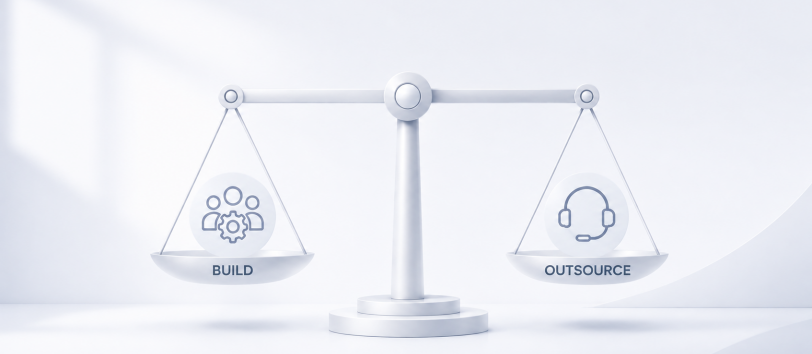
Why This Decision Is Harder Than It Looks
Technical support isn't like general customer service. It requires product knowledge, troubleshooting skills, and
often direct access to technical documentation, known issues, and escalation paths into engineering. That complexity
is exactly why the build-vs-outsource decision for technical support outsourcing carries more weight than it would for a
simpler support function — get it wrong, and either your users get inconsistent help, or your engineering team gets
buried in tickets that should never have reached them.
The Build Path: What It Actually Takes
Building an in-house technical support team looks straightforward on paper, but the real timeline and cost usually
surprise founders comparing hiring technical support team vs outsourcing for the first time.
Typical timeline to a functioning team:
-
Weeks 1–4: Writing job descriptions, sourcing candidates, and interviewing
-
Weeks 4–8: Hiring and onboarding, including product training
-
Weeks 8–12: Agents reach reasonable independence on Tier 1 issues
-
Months 4–6+: Team reaches consistent quality and handles Tier 2 issues with less oversight
What it costs beyond salary:
-
Recruiting time and cost (internal or via an agency)
-
Training time from your product and engineering teams
-
Support tooling and licenses (helpdesk, knowledge base, monitoring)
-
Management overhead — someone needs to run QA, scheduling, and performance reviews
-
Turnover risk, which is notably high in frontline support roles
Where building in-house genuinely wins:
-
Deep, product-specific institutional knowledge builds over time and stays with your company
-
Tighter, faster feedback loops with engineering and product teams
-
Full control over hiring, culture, and quality standards from day one
The Outsource Path: What It Actually Looks Like
Outsourcing shifts most of the hiring, training infrastructure, and management overhead to a partner, but it's
not simply "pay less and get the same thing" — it changes how support operates.
Typical timeline to a functioning team:
-
Weeks 1–2: Selecting a provider and scoping the engagement
-
Weeks 2–4: Onboarding agents on your documentation, known issues, and escalation rules
-
Weeks 4–6: Agents handling Tier 1 volume with acceptable quality
-
Weeks 6–10: Full ramp-up, including Tier 2 coverage if included in scope
What it costs beyond the hourly or per-ticket rate:
-
Time from your team to build and maintain documentation the outsourced team relies on
-
A point of contact on your side for ongoing quality review and escalation handling
-
Occasional retraining as your product changes
Where outsourcing genuinely wins:
-
Faster time to a functioning team, especially for Tier 1 and Tier 2 coverage
-
Lower fixed cost, converting a hiring and management burden into a predictable expense
-
Easier scaling up or down around launches, seasonal spikes, or uncertain growth
-
Access to 24/7 and multilingual coverage without building shift schedules internally
A Decision Matrix: Which Path Fits Your Situation
| Your Situation |
Likely Better Fit |
| Early-stage startup, low and unpredictable ticket volume |
Outsource (Tier 1, shared team) |
| Growing company needing to protect engineering time from Tier 1/2 tickets |
Outsource (dedicated Tier 1/2 team, Tier 3 stays in-house) |
| Company entering new markets needing multilingual coverage quickly |
Outsource |
| Mature product with highly complex, engineering-adjacent tickets as the majority of volume |
Build in-house, possibly with outsourced overflow |
| Highly regulated industry requiring strict internal control over all support interactions |
Build in-house, or onshore-only outsourcing with compliance experience |
| Company with steady, predictable volume and available management bandwidth |
Either path can work — decision comes down to cost priorities |
What Can Go Wrong With Each Path
Risks of building in-house:
-
Slower time to full coverage, especially painful if support gaps are already affecting customers today
-
Turnover forces you to restart onboarding and training cycles
-
Management overhead is easy to underestimate, especially for a first hire managing support
Risks of outsourcing:
-
Incomplete documentation leads to inconsistent or inaccurate agent responses
-
Choosing a generalist provider without real technical support experience
-
Unclear escalation paths, causing complex issues to get stuck in the outsourced queue or flood engineering
unfiltered
-
Treating the relationship as "set and forget" instead of maintaining ongoing quality review
How to Test the Outsourcing Path Without Full Commitment
If you're leaning toward outsourcing but want to validate the decision before switching entirely, most
experienced technical support outsourcing for startups and growing companies is structured around a limited pilot
first:
1. Start with Tier 1 only, keeping Tier 2 and Tier 3 in-house during the trial period.
2. Scope it to a single product area or ticket category rather than your full volume.
3. Set specific success metrics in advance — first-response time, resolution rate, and CSAT
targets.
4. Review actual ticket transcripts weekly, not just summary metrics, during the trial.
5. Expand gradually into Tier 2 and additional ticket categories only once Tier 1 quality is proven.

How Nexlence Supports This Decision
At Nexlence, we typically
work with technical teams at the exact point in this decision — often starting with a scoped Tier 1 pilot before
expanding further. Our agents are onboarded directly on your documentation, known issues, and escalation rules, with
transparent reporting from day one so you can evaluate the outsourcing path with real data rather than a sales
pitch.
Frequently Asked Questions
Is outsourcing technical support always cheaper than hiring in-house? Usually on a pure cost basis,
yes, especially once you factor in recruiting, training, tooling, and management overhead for an in-house team. But
cost isn't the only variable — deep, long-term product ownership tends to build faster in-house, which matters
more for highly complex or engineering-adjacent support.
Can I combine both approaches instead of choosing one? Yes, and many companies do. A common hybrid
model outsources Tier 1 (and sometimes Tier 2) while keeping Tier 3 and product-specific escalations in-house with
your engineering and product teams.
How long should a pilot period run before deciding to scale outsourcing further? Four to six weeks
is usually enough to see past initial ramp-up and get a realistic read on quality, provided you're reviewing
actual transcripts and checking in regularly rather than waiting until the end to evaluate.
What's the biggest reason technical support outsourcing goes wrong? Incomplete or outdated
documentation is one of the most common causes. An outsourced team's accuracy is only as good as the knowledge
base, known issues list, and escalation rules they're given to work from.
Is outsourcing a good fit for a very early-stage startup with unpredictable volume? Often yes,
particularly for Tier 1 coverage on a shared-team basis, since it avoids the fixed cost and management overhead of
hiring before you have steady, predictable volume.
Conclusion
The build-vs-outsource decision for technical support isn't about which approach is universally better — it's
about matching the right model to your current ticket volume, complexity, growth stage, and available management
bandwidth. Companies that get this right usually start with a clearly scoped pilot, whichever direction they lean,
and make the decision to scale based on real performance data rather than assumptions.
If you're weighing this decision for your own technical support and want to see what a scoped outsourcing pilot
could look like, Nexlence can walk through your ticket volume and complexity to help you map out the right starting
point.
Talk to Nexlence About Your
Technical Support Options →















 Nexlence


 PREVOUS ARTICLE