Quick Answer
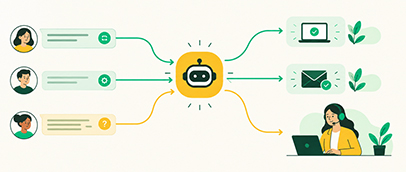
Customer support automation uses AI, workflows, knowledge bases, and other technologies to handle or assist with repetitive service activities. Businesses should begin by identifying suitable use cases, improving the accuracy of customer information, defining human escalation rules, and measuring whether automation improves resolution and customer satisfaction.
What Is Customer Support Automation and How Can Businesses Get Started?

A customer sends a message asking where an order is. Another customer wants to reset an account password. A third customer has a complicated complaint involving a damaged product and a delayed refund.
Although these requests all arrive through customer service channels, they do not require the same type of response.
Some can be resolved through accurate information and a simple workflow. Others require investigation, discretion, or a human conversation.
This distinction is central to customer support automation.
As businesses explore an automate customer service experience solution, the goal should not be to automate every interaction. The more useful objective is to reduce unnecessary effort while ensuring that customers can still receive appropriate human assistance.
Automation can help businesses organize information, answer routine questions, route requests, and support agents. But its value depends on how well it fits the actual customer journey.
What Does Customer Support Automation Include?
Customer support automation refers to technologies and workflows that perform service-related tasks with limited manual intervention.
The simplest examples include automated ticket routing, email acknowledgments, and rule-based responses. More advanced systems may use AI to interpret customer questions, retrieve information, recommend answers, or assist agents during live interactions.
Automation can operate before a human agent becomes involved, during an interaction, or after a case has been resolved.
| Automation capability | Example | Potential operational value |
|---|
| Automated routing | Assigning tickets according to topic or language | Reduces manual assignment work |
| Knowledge-based answers | Providing information from approved resources | Helps customers find routine answers |
| AI-assisted agent support | Suggesting relevant information during a conversation | Reduces time spent searching |
| Workflow automation | Triggering predefined actions after a request | Improves process consistency |
| Conversation summarization | Creating a summary for the next agent | Reduces repeated explanations |
| Intent classification | Identifying the type of customer request | Supports routing and prioritization |
| Automated status updates | Sending information about an order or case | Reduces repetitive inquiries |
These capabilities should be selected according to the company’s actual service processes.
1. Start With the Customer Problem, Not the Technology
A common mistake is to begin an automation project by selecting a chatbot or AI platform before understanding how customers currently receive support.
The business should first examine the types of inquiries it receives, how frequently they occur, and how much effort is required to resolve them.
For example, a large number of order-status inquiries may indicate that customers cannot easily access delivery information. In this case, improving order visibility may be more valuable than simply adding a chatbot.
Similarly, repeated questions about product specifications may suggest that the website or knowledge base needs clearer information.
Automation works best when it addresses a defined problem.
A business should therefore identify where customers experience unnecessary waiting, repeated questions, confusing navigation, or inconsistent answers.
2. Choose the Right Tasks to Automate

Not every support task has the same level of automation suitability.
Routine, predictable, and low-risk requests are generally easier to automate than complex situations involving judgment or emotional sensitivity.
For example, an automated workflow may help customers locate an order number or receive a basic account instruction. A complicated complaint involving a major financial impact may require a human agent from the beginning.
The following framework can help businesses decide where to start.
| Task characteristic | Automation suitability |
|---|
| Repetitive and predictable | Generally suitable for automation |
| Based on clear, approved information | Suitable for knowledge-based assistance |
| Requires access to structured account data | May be suitable with appropriate system integration |
| Involves unusual circumstances | Usually needs human review |
| Emotionally sensitive or high-risk | Human involvement may be necessary |
| Requires complex judgment | Better suited to trained agents or assisted automation |
The objective is not to maximize the percentage of automated interactions. It is to use automation where it improves the experience without creating additional friction.
3. Build a Reliable Knowledge Foundation
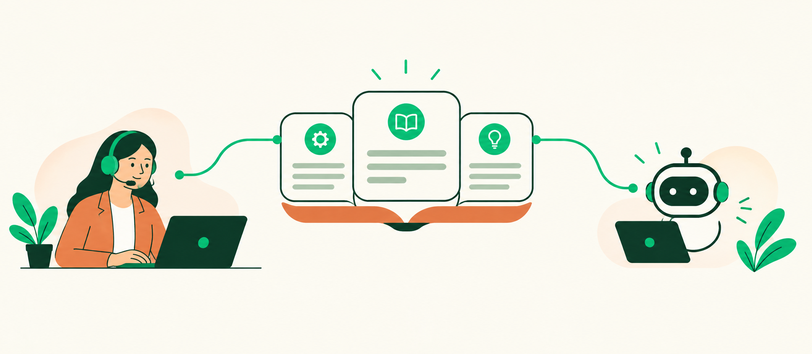
AI-based customer support depends heavily on the quality of the information it uses. If product policies are incomplete, outdated, or contradictory, an automated system may provide incorrect or confusing answers.
Before introducing automation, a company should review its customer-facing information, including product documentation, return policies, delivery instructions, account procedures, and escalation rules.
The information should be organized in a way that allows both customers and agents to find the correct answer.
This is particularly important for businesses with frequently changing products or policies. An automated system that uses outdated information may create more support work instead of reducing it.
A reliable knowledge foundation also helps human agents. When the same information is used across automated and human-assisted interactions, customers are less likely to receive conflicting answers.
4. Design Human Escalation Into the Process
A customer support automation system should have a clear method for transferring an interaction to a human agent.
This is not merely a backup feature. It is an important part of the customer experience.
Customers may need human assistance when the automated system cannot understand the request, when the information is insufficient, or when the situation involves a complaint or exception.
The escalation process should preserve the context of the conversation wherever possible. Customers should not have to repeat the same information several times after being transferred.
Research published in the Journal of Retailing and Consumer Services found that combining chatbot support with limited human intervention could achieve customer outcomes comparable to a more human-intensive service condition in the studies examined.
This suggests that the relationship between automation and human service is not necessarily a choice between two completely separate models. In some situations, the two can work together.
5. Use Automation to Assist Human Agents
Automation does not have to communicate directly with customers to create value. It can also support the people who handle customer interactions.
For example, AI-assisted tools may help agents locate relevant information, summarize previous conversations, classify requests, or identify the next step in a workflow.
This can reduce repetitive administrative work and allow agents to spend more time understanding the customer’s actual problem.
However, agent assistance should be evaluated carefully. Suggested answers need to be accurate, relevant, and easy for agents to review before they are sent to customers.
Human agents should retain appropriate responsibility for decisions that require judgment.
6. Measure Automation Through Customer Outcomes
A business should not judge automation only by the number of conversations handled by a bot.
A high automation rate may look impressive, but it does not necessarily mean that customers are receiving better service.
More useful measures include:
| Metric | Why it matters |
|---|
| Automated resolution rate | Shows how many requests are completed without human intervention |
| Escalation rate | Helps identify where automation needs human support |
| Repeat contact rate | Indicates whether customers received a satisfactory answer |
| Resolution time | Shows how quickly issues are completed |
| Customer satisfaction | Captures customer perception of the interaction |
| Accuracy rate | Measures whether information provided is correct |
| Agent handling time | Indicates whether automation is reducing manual effort |
| Abandonment rate | Shows whether customers leave before receiving assistance |
These metrics should be reviewed together. For example, a decrease in human escalations may be positive, but only if customers are still receiving accurate and satisfactory answers.
7. Avoid Automating the Wrong Customer Experience
Automation can create frustration when it becomes a barrier between customers and the assistance they need.
A customer who has already explained a problem may become more frustrated if the system repeatedly offers irrelevant options. The problem becomes worse when there is no clear way to reach a human agent.
Research in the Journal of Consumer Research found that consumers may evaluate service provided by bots less positively than equivalent service provided by humans, partly because they may perceive automation as prioritizing company benefits over customer benefits.
This does not mean automation is unsuitable for customer service. It means businesses should consider how automation is presented and whether customers believe it is helping them.
A well-designed system should make routine interactions easier while providing a clear path to human support when necessary.
Nexlence and the Role of AI-Assisted Customer Experience
Nexlence combines AI-enabled technology with human operations to support customer experience across digital and customer service channels.
An AI-assisted approach can help businesses organize customer interactions, support real-time information access, and improve the coordination between automated processes and human agents.
For businesses evaluating an automate customer service experience solution, the most important consideration is how technology fits into the broader service operation.
Automation should support accurate information, efficient workflows, and appropriate human involvement rather than operate as an isolated tool.
FAQ
What is customer support automation?
Customer support automation uses technology to perform or assist with repetitive customer service tasks. It may include chatbots, automated workflows, ticket routing, knowledge-based responses, and AI tools that assist human agents.
Can customer support automation replace human agents?
Automation can handle certain routine tasks, but it does not eliminate the need for human agents in every situation. Complex, sensitive, or unusual cases may still require human judgment and communication.
What should a company automate first?
Businesses often begin with predictable, low-risk tasks such as frequently asked questions, ticket categorization, basic status updates, and routine workflow actions. The right starting point depends on the company’s customer service data.
How can automation improve customer experience?
Automation may reduce waiting, provide faster access to information, simplify routine tasks, and help agents respond more efficiently. Its impact depends on accuracy, usability, and the availability of human escalation.
What are the main risks of customer support automation?
Common risks include inaccurate information, poor escalation, outdated knowledge bases, limited understanding of unusual requests, and customer frustration when automated systems make human assistance difficult to access.
Conclusion
Customer support automation is most effective when it is designed around real customer problems.
Businesses should begin with suitable use cases, establish reliable information, define human escalation rules, and measure whether automation improves both operational performance and customer outcomes.
The strongest approach is not necessarily to automate the largest possible share of interactions. It is to combine technology and human expertise in a way that makes customer service more accurate, accessible, and consistent.
Related guide:AI Driven Customer Experiences: How AI Is Transforming the Future of Customer Experience
Sources
Henkel, A. P., Understanding and Improving Consumer Reactions to Service Bots, Journal of Consumer Research, 2023.
Can chatbot customer service match human service agents on customer satisfaction? An investigation in the role of trust, Journal of Retailing and Consumer Services, 2024.
Gartner, Customer Service Research.















 Nexlence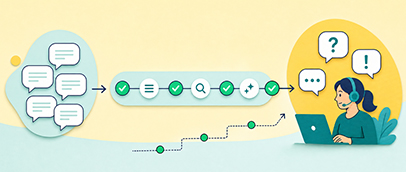
 PREVOUS ARTICLE