A direct-to-consumer skincare brand launches a new product at midnight. By 2 a.m., the drop has sold out — and so has
the brand's support inbox. A customer's order confirmation never arrived. Another received the wrong shade.
A third posted a screenshot of an unanswered chat window to social media, tagging the brand directly. There's no
store manager to escalate to, no regional call center on standby, no wholesale partner absorbing the complaint. Just
the brand, its customers, and whatever support system it built (or didn't) in advance.
This is the reality of running a DTC business: every interaction is direct, which means every mistake is direct too.
There's no retailer standing between the brand and the person who's upset. That's exactly why dtc customer experience
has
become one of the most scrutinized parts of the entire business model — not a nice-to-have layered on top of the
product, but the thing that determines whether a customer becomes a repeat buyer or a public complaint.
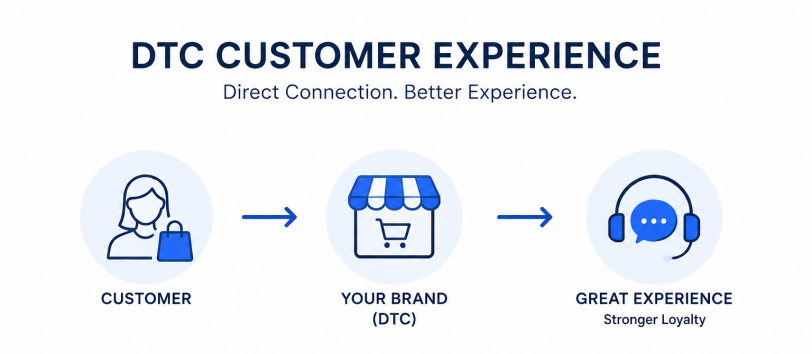
Why DTC Customer Experience Works Differently Than Traditional Retail
When a brand sells through a retailer, the retailer absorbs a lot of the customer relationship — checkout friction,
returns, in-store questions. When a brand sells direct, all of that responsibility sits with the brand itself. The
upside is real: direct access to first-party data, full control over messaging, and the ability to build a
relationship instead of a transaction. The downside is that dtc customer experience carries the full weight of the
brand's reputation on every single touchpoint, from the unboxing to the return process.
That structure creates a few pressures unique to the DTC model:
-
There's no buffer. A bad interaction reflects on the brand directly, with no retailer to
share the blame or the resolution.
-
Consistency has to hold across every channel. Social media, email, live chat, and
post-purchase support all need to sound like the same brand, or the experience starts to feel disjointed.
-
The stakes rise with every touchpoint added. As DTC brands expand into more channels —
subscriptions, loyalty programs, international shipping — the number of moments where the experience can
break also multiplies.
What the Data Says About Getting It Right
The businesses that treat this seriously tend to see it show up in hard numbers, not just brand sentiment. According
to customer experience platform Yext, citing research from web usability firm Baymard Institute, a significant share
of shoppers abandon their carts specifically because the checkout process feels too long or too complicated — a
reminder that a big part of dtc customer experience happens before a support ticket is ever filed.
On the brand-consistency side, CMSWire has reported that DTC brands which keep their messaging and tone consistent
across every customer touchpoint tend to see stronger conversion and a more engaged social following, citing the
beauty brand Colourpop as an example of a company whose consistent, on-brand voice across channels has helped build
a large and loyal online audience. The lesson generalizes well beyond one brand: it isn't just about resolving
problems quickly — it's about making every touchpoint, good or bad, feel like it came from the same company.
What a Strong DTC Customer Experience Actually Requires
Pulling this off consistently, especially while scaling into new markets, usually comes down to a few operational
pillars:
1.24/7, multilingual coverage. DTC customers don't wait for business hours, and international buyers
don't wait for a time zone to align.
2.AI-assisted triage paired with human judgment. Routine questions — order status, sizing, return
policy — can be resolved instantly through automation, while sensitive or emotionally charged interactions still
need a trained person.
3.A unified voice across every channel. Chat, email, and social replies all need to reflect the same
brand tone, or the relationship starts to feel inconsistent.
4.Data that feeds back into the business. Return reasons, common complaints, and support trends
should inform product and marketing decisions, not just get logged and forgotten.
5.Flexible capacity for launch spikes and seasonal demand. A single viral moment or product drop can
multiply ticket volume overnight, and the support system needs to flex with it.
Very few brands can build all five of these in-house from day one — which is exactly why so many turn to a
specialized CX partner rather than trying to solve it alone.
How Nexlence Approaches DTC Customer Experience
Nexlence builds its CX
model specifically around the pressures described above, combining AI-powered automation with multilingual human
teams rather than treating the two as separate options. For DTC and e-commerce brands in particular, that translates
into a few concrete capabilities:
-
A dual-engine model built for consistency. Nexlence pairs AI agents with trained human
specialists so that routine cases get resolved instantly, while complex or emotionally sensitive
interactions still get a human touch — keeping the brand voice consistent across every channel.
-
Teams fluent in the audiences DTC brands actually sell to. Nexlence's localized teams
are built to understand Gen Z and digitally native consumers specifically — their language, channel habits,
and expectations for immediacy and authenticity — rather than applying a generic script across every market.
-
A global delivery network that scales with launch-day spikes. With more than 20 delivery
centers and 5,000+ professionals worldwide, Nexlence can absorb sudden volume from a product drop, a viral
moment, or a seasonal campaign without a lengthy ramp-up.
-
An AI + data platform that turns support into insight. Through its X-Force AI platform and
connected data tools, Nexlence surfaces patterns from support interactions — the kind of feedback loop that
lets a brand fix a sizing chart or update packaging before the same complaint repeats at scale.
-
Compliance-aware operations for brands selling across borders. Nexlence's global
compliance knowledge base covers data privacy, platform policy, and transaction risk, which matters as DTC
brands increasingly ship and support customers internationally.
-
Unified global CX standards. Rather than letting tone and quality drift by region, Nexlence
applies standardized service processes and brand voice guidelines across every market it operates in, so the
experience feels the same whether a customer is in Berlin or Bogotá.

FAQ: DTC Customer Experience
What makes DTC support harder to manage than traditional retail support?
There's no retailer standing between the brand and the customer, so every touchpoint — good or bad — reflects
directly on the brand. Consistency, speed, and tone all matter more because there's nowhere else for the
responsibility to sit.
Can AI actually improve the customer experience, or does it make things feel impersonal?
Used well, AI handles the repetitive, high-volume questions instantly — freeing human agents to focus on the
interactions that genuinely need empathy or judgment. The brands that get this balance right tend to see faster
resolution times without sacrificing the personal feel customers expect from a DTC brand.
How quickly can a DTC brand scale its support during a product launch or viral moment?
This depends entirely on whether the underlying infrastructure already exists. A partner with delivery centers and AI
workflows already running can typically absorb a spike within days, while building that capacity in-house from
scratch usually takes months.
Does outsourcing support hurt the personal feel that DTC brands are known for?
Not if the partner is chosen carefully. A provider that blends AI with human specialists trained specifically on the
brand's voice and audience can maintain — and in some cases improve — the personal touch, especially compared to
an internal team that's stretched too thin to respond quickly.
Conclusion
The DTC brands that come out ahead aren't necessarily the ones with the biggest support teams — they're the
ones whose customer experience holds together under pressure, at 2 a.m., during a product launch, across every
channel a customer might use. Getting dtc customer experience right means treating support not as a cost to
minimize, but as one of the clearest signals a brand sends about who it really is.
If your team is feeling that pressure — a launch that outpaced your support capacity, a growing list of markets you
can't cover in the right language, or an experience that feels inconsistent across channels — that's
precisely the gap Nexlence is built to close. Its dual-engine model, global delivery network, and Gen Z–fluent teams
exist to make sure that the next 2 a.m. product drop becomes a growth story instead of a support crisis. Reach out
to Nexlence to map out where
your current support is under the most strain, and where AI-driven automation and multilingual human expertise could
relieve that pressure first.














 Nexlence


 PREVOUS ARTICLE