We use cookies to improve our site. By using or further navigating our site you accept our cookie policy.Please click here to check the Privacy Policy and Cookie Policy.



Smart
Empowerment

2026-10-09
 Nexlence
Outsourced social media customer service means using an external customer service team to manage customer questions, complaints, direct messages, comments, and other service interactions across social platforms. Depending on the scope, the team may monitor conversations, answer routine questions, support livestreams, handle multilingual interactions, move sensitive cases into private channels, and escalate issues that require decisions from the brand.
The reason companies outsource this work is not simply to get more people answering comments. Social media combines customer service with public communication. A customer asking about an order in a private email is having a one-to-one conversation. The same customer asking the question beneath a product video may be speaking in front of hundreds of other customers.
That difference changes how the complaint needs to be handled.
For brands operating across TikTok, Douyin, Kuaishou, and other digital channels, a useful outsourced operation therefore needs to do more than respond quickly. It needs to understand the platform, recognize the type of issue, use the right response channel, and know when a frontline agent should stop responding and involve someone internally.
A customer complaint does not become more serious simply because it appears on social media. What changes is its visibility.
A normal customer service conversation usually stays between the customer and the company. A public comment can attract replies from other customers, be quoted elsewhere, or become part of a larger discussion about the brand. The original customer is no longer the only person evaluating the company's response.
This makes the wording of the response important, but not because every comment needs a carefully crafted public statement.
The first priority is usually understanding what the customer actually needs.
A customer writing, “Where is my order?” may only need delivery information. Someone writing, “I have contacted support three times and nobody has solved this” is presenting a different problem. The issue is no longer just the order. The company now needs to understand what happened in the previous interactions and why the case remains unresolved.
A generic response such as “Please contact our customer service team” may technically direct the customer somewhere, but it does not demonstrate that the company has understood the complaint.
This is one of the reasons social media customer service requires trained agents rather than simply assigning existing social media staff to answer comments when they have time.
The agent needs access to customer service information, knowledge of the brand's policies, and enough context to decide whether the issue can be handled immediately or needs further investigation.
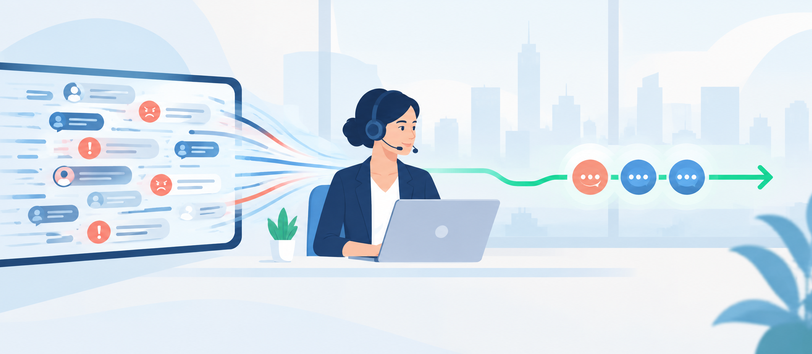
Short-video and livestream platforms add another layer to customer service because conversations can happen directly around content that is already attracting attention.
TikTok explains that its recommendation systems consider signals such as user interactions, including likes, shares, comments, and viewing behavior. Its LIVE recommendations also take interactions and other engagement signals into account.
That does not mean that every negative comment will become viral. It does mean that brands should not assume that a complaint will remain isolated simply because it started with one customer.
A complaint under a product video can attract responses from other customers who experienced something similar. A customer can also discuss the issue in another video, or raise it during a livestream where the conversation is visible to everyone watching.
The operational problem is therefore less about predicting whether a complaint will go viral and more about recognizing when an ordinary support issue is turning into a broader customer service problem.
Consider a livestream where several customers begin asking about delayed deliveries. The first question might be routine. If similar questions appear repeatedly, however, the issue may indicate a fulfillment problem affecting more customers than the support team initially realized.
An effective social media operation needs to recognize that pattern.
This is also why a team experienced only with traditional email or phone support may need additional training before taking responsibility for short-video and livestream channels. The environment is different, and the customer service workflow has to reflect that.

The scope varies from one business to another. Some companies outsource only after-hours monitoring. Others outsource social comments, direct messages, multilingual support, or livestream customer assistance.
A typical operation can include several different activities.
| Function | What the Team Handles | Why It Matters |
|---|---|---|
| Social monitoring | Comments, mentions, messages, and customer questions | Identifies service issues where customers are already communicating |
| Comment support | Routine product, order, and service questions | Resolves straightforward issues without unnecessary escalation |
| Direct-message support | Private conversations that require additional customer information | Provides a more appropriate channel for account-specific cases |
| Livestream support | Questions and complaints during live sessions | Prevents customer issues from being ignored during high-volume periods |
| Multilingual support | Customer interactions in different languages | Helps brands maintain consistent service across markets |
| Case escalation | Sensitive, unusual, or unresolved complaints | Moves decisions to the appropriate internal team |
| Quality assurance | Review of conversations and agent performance | Helps identify inaccurate, inconsistent, or inappropriate responses |
| Reporting | Interaction volume, recurring issues, and service trends | Gives the internal team visibility into what customers are experiencing |
This distinction matters because “social media support” can mean very different things from one provider to another.
One company may provide a few agents to answer comments. Another may provide a structured operation connecting social interactions with the brand's wider customer service process.
Those are not equivalent services.
The first response does not always need to solve the entire problem.
In many cases, the purpose of the first response is to acknowledge the issue and establish the next step.
For example, if a customer posts publicly about an order problem, the agent can acknowledge the concern and invite the customer to continue through a private channel where order information can be checked.
This approach has two advantages.
The customer receives a visible acknowledgment rather than being ignored, while sensitive information does not need to be discussed publicly.
The important part is what happens after the conversation moves to private messaging.
If the customer is simply told to wait again, the public response has solved very little. The agent needs to be able to access the appropriate information or hand the case to someone who can.
This is where the connection between social media support and the wider customer service operation becomes important.
A social media agent should not have to reinvent the process for every complaint. There should be defined procedures for common cases such as delivery problems, returns, refunds, account issues, product questions, and service complaints.
At the same time, not every situation should be forced into a script.
A customer who has already contacted support several times may need a different response from someone asking the same question for the first time.
Escalation should be based on the nature of the issue, not simply on how angry the customer sounds.
A useful escalation framework might distinguish between routine cases and situations that could create operational, legal, safety, or reputational concerns.
| Situation | Frontline Response | Escalation |
|---|---|---|
| Routine product question | Provide approved information | Usually unnecessary |
| Order or delivery issue | Verify available information and assist | Escalate unresolved cases |
| Repeated complaint about the same problem | Address the individual case | Flag recurring issue for review |
| Refund or account dispute | Follow approved policy | Escalate exceptions |
| Safety-related complaint | Avoid unsupported claims | Immediate internal review |
| Legal or regulatory concern | Do not improvise a response | Internal or legal review |
| Sensitive personal information | Move conversation away from public comments | Follow internal data procedures |
| Large number of similar complaints | Handle individual customers | Alert operations team to investigate the wider issue |
This structure protects both sides.
Customers are less likely to receive contradictory answers, while agents are less likely to make decisions that exceed their authority.
It also gives the internal team a clearer picture of what is happening.
If one customer complains about a delivery problem, it may be an individual case. If fifty customers report the same problem within a short period, the customer service team should not simply process fifty unrelated tickets.
The repeated complaints may be evidence of a larger operational issue.
A common way of explaining customer service outsourcing is that it gives a company more capacity.
That is true, but it does not explain the whole value.
The more important change can be the way customer service work is organized.
Imagine an internal team responsible for email, live chat, phone support, social media, and customer complaints. During normal periods, the workload may be manageable. A product launch or livestream can suddenly increase social interactions several times over.
The company then has to decide whether internal employees should stop other work to handle the increase, whether response times should be allowed to grow, or whether additional staff should be hired even though the higher workload may only last for a limited period.
An outsourced operation can absorb part of that variable workload.
The external team can handle defined customer interactions while internal employees focus on areas where company-specific knowledge and decision-making are more important.
This can change the skills the internal team needs.
Instead of spending most of the day monitoring comments and answering repetitive questions, internal customer service managers can focus more heavily on policy, escalation, quality standards, product issues, and the decisions that the external team is not authorized to make.
Outsourcing therefore does not necessarily mean moving the entire customer service function outside the company.
It can mean dividing the work according to where external operational capacity is useful and where internal ownership remains necessary.
Outsourcing does not automatically improve customer service.
The first risk is insufficient product knowledge.
An agent can follow a response template perfectly and still give the wrong answer if the underlying product information is outdated or incomplete.
The second is loss of brand context.
A response can be grammatically correct and professionally written while still sounding completely wrong for the brand's customers.
This becomes more noticeable on platforms where conversations are informal and fast-moving.
The third risk is over-standardization.
Templates are useful for common questions, but customers quickly notice when every complaint receives almost identical wording.
A scripted response may be appropriate for “What are your delivery times?” It is much less appropriate for a customer who has explained a complicated problem in several paragraphs.
The fourth risk is poor escalation.
If the external team does not know which cases require internal review, agents may either escalate too many routine questions or attempt to resolve sensitive issues themselves.
Both create problems.
The fifth is fragmented customer information.
If the social media team cannot connect a conversation with the customer's existing service history, the customer may have to explain the same issue repeatedly.
For this reason, businesses should evaluate an outsourcing provider on more than staffing numbers and response-time promises.
For international brands, social media customer service creates another challenge: customers do not simply communicate in different languages. They may also communicate differently.
The same complaint can be expressed formally in one market and much more directly in another. Some customers expect a detailed explanation; others want a short answer and a clear next step.
Literal translation does not solve that problem.
Agents need to understand the product information, service policies, local communication habits, and the context of the platform they are supporting.
This becomes especially important when a brand operates across markets where social commerce and livestream shopping are major parts of the customer journey.
A customer asking about a product during a livestream is not necessarily looking for the same interaction as a customer submitting a formal support request by email.
The language, timing, and context all matter.

AI can help social customer service teams deal with large volumes of information, but the useful question is not whether AI can replace agents.
The more practical question is which parts of the workflow should be automated and which should remain under human control.
AI can assist with activities such as classifying incoming interactions, retrieving relevant knowledge, identifying repeated topics, supporting agents with information, and analyzing large numbers of conversations.
Human agents remain important when a case requires judgment.
For example, an automated system may identify that hundreds of customers are discussing delivery delays. That information is useful, but it does not decide whether the appropriate action is a public announcement, a logistics investigation, an individual response, or an escalation to management.
Similarly, AI can help an agent find an approved answer, but the agent still needs to recognize when the customer's actual situation falls outside the standard answer.
This is why an AI-plus-human model can be useful for social customer service.
Technology handles parts of the volume and information workload. Human agents handle the context and decisions that cannot be reduced to a standard rule.
Not every company needs to outsource social customer service.
A small business with limited social interactions may be able to manage everything internally.
The decision becomes more relevant when the workload starts competing with other customer service responsibilities.
Common situations include:
The scope can also be limited.
A company does not necessarily need to outsource every social interaction. It could outsource after-hours coverage, multilingual support, livestream assistance, routine inquiries, or specific platforms while keeping sensitive cases and policy decisions inside the company.
That makes outsourcing a question of operational design rather than a simple decision between “in-house” and “outsourced.”
For brands looking to outsource part of their customer service operation, Nexlence provides customer support across digital channels, including social media and multilingual customer operations, using a combination of AI-enabled capabilities and human support.
The important distinction is that social media customer service can be treated as one part of a wider customer service operation rather than a standalone social media function. This allows businesses to define which interactions are handled externally while retaining internal ownership of policies, sensitive decisions, and broader customer experience standards.
For companies evaluating customer service outsourcing services, this approach can make it easier to start with a specific operational need and expand the scope when the workflow is proven.
Related guide: Call Center BPO Services: A Guide to Choosing the Right Customer Support Partner
No. The brand can retain ownership of its communication standards, policies, escalation rules, and approval requirements while the external team handles defined customer service activities.
The important part is making those standards practical enough for agents to use during real conversations rather than relying on a document that exists only for onboarding.
There is no universal response time that works for every platform or situation.
A routine comment may not require the same urgency as a complaint appearing during a livestream or a large number of customers reporting the same problem.
Businesses should define response targets according to channel, interaction type, operating hours, and severity rather than applying one number to every case.
No.
A public acknowledgment may be useful, but cases involving order details, account information, payments, personal information, or other sensitive matters should generally move into an appropriate private support channel.
The transition should be handled carefully so that customers do not feel they are simply being redirected somewhere else without assistance.
Potential disadvantages include weaker product knowledge, inconsistent brand voice, poor escalation, overuse of scripts, fragmented customer information, and reduced visibility if the outsourcing relationship is poorly managed.
These risks can be reduced through structured onboarding, knowledge management, quality assurance, reporting, and clearly defined responsibilities between the provider and the brand.
Yes. Social media is one of several channels that can be included in an outsourcing model alongside email, live chat, messaging, multilingual support, and other customer service operations.
Businesses considering customer service outsourcing services should evaluate how social interactions connect with the rest of the customer journey rather than treating the channel as a separate activity.
A viral complaint rarely begins with a company deliberately creating a crisis. More often, it starts with an ordinary customer problem that is handled poorly, left unresolved, or repeated by other customers.
But trying to prevent every complaint from becoming visible is not the right objective.
Customers will complain. Some problems will happen publicly. Some issues will take time to resolve.
What matters is whether the business has a process for recognizing the difference between a routine question, an unresolved service problem, and an issue that requires immediate internal attention.
That process needs trained people, accurate information, clear escalation rules, appropriate platform knowledge, and enough operational capacity to work when customer demand changes.
Outsourcing can provide some of those capabilities without requiring a company to build the entire operation internally. But the quality of the result depends on how the relationship is structured.
The strongest model is not simply the one that produces the fastest reply.
It is the one that knows what to answer, where to answer it, when to move the conversation, and when not to answer without internal approval.

















 PREVOUS ARTICLE
