We use cookies to improve our site. By using or further navigating our site you accept our cookie policy.Please click here to check the Privacy Policy and Cookie Policy.



Smart
Empowerment

2026-10-29
 Nexlence
Agentic AI for customer service refers to AI systems that can work toward a defined goal, use connected tools, and execute multiple steps within set permissions. Unlike a chatbot that primarily answers questions, an AI agent may retrieve an order, check a policy, update a support case, or initiate an approved workflow. Its capabilities depend on system integrations, access rights, and business rules. For most organizations, the practical starting point is to automate well-defined tasks, verify consequential actions, and retain human oversight for exceptions.
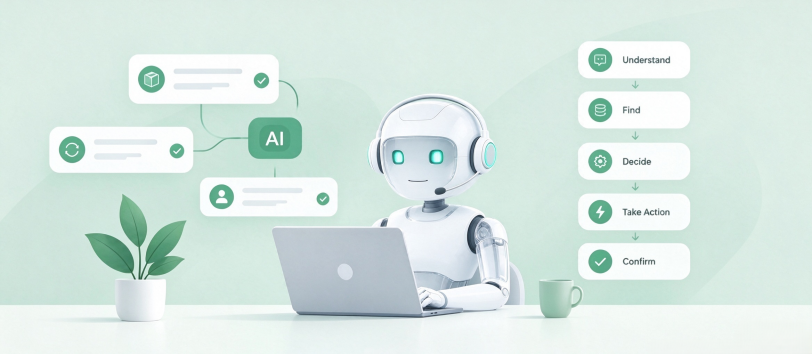
A chatbot typically responds to customer input. An agentic system can take a more active role in completing a task by deciding which permitted steps to take, using available tools, and checking whether the intended outcome has been achieved.
Consider a customer who wants to know why a refund has not arrived.
A basic chatbot might explain the refund policy and provide a standard processing timeline. A tool-enabled AI agent could retrieve the order, check the refund record, review the relevant policy, and provide a status based on the available data. If the system has the appropriate authorization, it might also initiate an eligible next step or create a case for review.
The difference is not simply more natural conversation. It is the ability to move from answering a question to carrying out a workflow.
The term agentic AI is used broadly, and not every product marketed as an AI agent has the same level of autonomy. Some systems retrieve information and recommend actions; others can execute approved operations across connected applications. Businesses should evaluate actual capabilities rather than rely on product labels.
The most practical applications involve tasks with identifiable inputs, clear rules, and verifiable outcomes.
Order and delivery inquiries. An agent can retrieve order details, check available tracking information, and explain the current status. If the data is incomplete or contradictory, the workflow should stop rather than invent an answer.
Returns and refunds. An agent may check eligibility, collect required information, and prepare or execute an authorized action. Exceptions, disputed charges, and unusual requests may require human approval.
Ticket management. AI can classify incoming cases, identify missing details, assign a priority, update records, and route requests to the appropriate team.
Account and subscription requests. Where integrations and permissions allow, an agent may guide customers through approved account changes, subscription updates, or cancellation procedures. Identity verification and confirmation requirements still apply.
Agent assistance. An AI agent can gather relevant records, summarize the issue, and prepare suggested responses before a human representative takes over.
| Use case | Potential agent actions | Essential control |
|---|---|---|
| Order tracking | Retrieve status and summarize delays | Use current, verified order data |
| Refund requests | Check eligibility and prepare a request | Enforce policy and approval rules |
| Ticket handling | Classify, update, and route cases | Validate priority and routing |
| Account changes | Collect details and initiate approved changes | Verify identity and authorization |
| Complex complaints | Gather history and prepare a summary | Transfer ownership to a human when needed |
These capabilities are not automatic features of every agent. They require suitable integrations, reliable data, and explicitly defined permissions.
A typical workflow has five stages.
Interpret the request. The system identifies what the customer wants to accomplish, such as checking a shipment or requesting a refund.
Gather relevant information. It retrieves the records, policies, and conversation history required to evaluate the request.
Determine the next permitted action. Based on the available information and business rules, the agent selects an appropriate step. If critical details are missing, it asks for clarification or escalates the case.
Execute the action. The agent uses connected tools to complete an authorized operation, such as updating a ticket or submitting a request for approval.
Verify and communicate the result. It checks the system response before telling the customer what happened. If the action fails or the outcome remains uncertain, it should explain the limitation and route the case appropriately.
This final verification step is particularly important. A message saying that a refund has been processed is not proof that the transaction succeeded. The agent needs confirmation from the relevant system.
A reliable workflow therefore includes defined stopping conditions, error handling, and a way to transfer unresolved cases without losing context.
Greater autonomy introduces risks beyond those associated with generating an inaccurate answer. An agent can potentially change records, trigger transactions, or carry an incorrect interpretation through several steps.
Incorrect actions at scale. If a business rule is misconfigured, an agent may apply it to many cases before the problem is detected. Start with limited permissions and test workflows against realistic exceptions.
Excessive system access. An agent that can read and modify every customer record has more access than most tasks require. Restrict permissions to the specific systems and actions needed for each workflow.
Unreliable information or reasoning. An agent may misunderstand a request, retrieve outdated information, or choose an inappropriate next step. Validate important inputs and use system-level checks rather than relying solely on the model's confidence.
Unclear accountability. When an automated action causes a problem, the business needs to identify what the agent did, which rules applied, and who is responsible for resolving the case.
Customer data exposure. Agent workflows may bring together information from multiple applications. Access controls, data minimization, retention policies, and appropriate monitoring should be considered during deployment.
The National Institute of Standards and Technology's AI Risk Management Framework provides a useful basis for identifying and managing these risks throughout the AI lifecycle. For customer service applications, the key is to build controls into the workflow rather than depend on staff to catch every error after execution.
Not every task should receive the same level of autonomy. The appropriate level depends on the consequences of an error, the clarity of the business rules, and whether the result can be reversed.
| Autonomy level | Example | Suitable control |
|---|---|---|
| Information retrieval | Check an order status | Verify data before responding |
| Recommended action | Suggest a refund based on policy | Human reviews the recommendation |
| Approved execution | Update a ticket or submit an eligible request | Apply permissions and log the action |
| Consequential action | Issue a refund or make a sensitive account change | Require additional checks or approval where appropriate |
A sensible deployment begins with information retrieval and low-risk administrative tasks. Once the system demonstrates reliable performance, the business can consider expanding its permissions.
Actions involving money, identity, account access, or irreversible changes deserve stricter controls. Depending on the use case, these may include explicit customer confirmation, human approval, transaction limits, or additional identity checks.
Businesses should also define when an agent must stop. Conflicting records, missing authorization, repeated tool failures, and requests outside approved policy should trigger a controlled response rather than an improvised decision.
A convincing demonstration is not enough to establish operational readiness. The system needs to work with the company's actual data, applications, policies, and exception handling procedures.
Integration and data access. Can the agent retrieve the information it needs from the CRM, order management system, ticketing platform, or knowledge base? Are the records sufficiently current and consistent?
Action verification. Can the agent confirm that an update or transaction succeeded? Does it distinguish a submitted request from a completed action?
Permissions and auditability. Can access be limited by task? Are actions and system responses recorded so that teams can investigate failures?
Exception handling. What happens when records conflict, a request falls outside policy, or a connected tool becomes unavailable? Can the agent transfer the case with a useful summary?
Operational performance. Does the workflow reduce manual effort without increasing repeat contacts, incorrect actions, or time spent correcting errors?
A pilot should use representative cases, including unusual requests and failure scenarios—not only straightforward interactions. Businesses should compare results against their existing process and establish clear criteria for expanding deployment.

Agentic AI is one component of a customer service operating model, not a substitute for the entire operation. Its effectiveness depends on the quality of the knowledge base, connected systems, business procedures, and the people responsible for managing exceptions.
For organizations serving multiple markets, workflows must also account for different languages, local policies, and communication expectations. AI can assist with multilingual interactions, while human teams provide context and review cases that require more than direct translation.
This becomes particularly relevant when businesses combine automated workflows with outsourced customer service operations. Responsibilities for escalation, quality assurance, data access, and policy updates need to be clearly defined across internal and external teams.
For more on this operating model, see Customer Service AI Agents, which covers the broader selection and deployment of AI-supported customer service. Businesses reviewing how automation fits alongside human delivery can also explore Nexlence's customer service outsourcing services.
No. Generative AI produces content such as text or summaries. Agentic AI describes a system's ability to work toward a goal through steps such as selecting tools, retrieving information, and executing permitted actions. An agent may use a generative AI model, but generating text alone does not make a system an autonomous agent.
It can resolve some well-defined tickets if it has the necessary data, system access, and authorization. Cases involving conflicting information, exceptions, or sensitive decisions should follow predefined escalation rules.
Depending on the use case, it may need access to CRM software, ticketing systems, order management platforms, knowledge bases, payment records, or identity verification services. Integrations should be limited to what the workflow requires.
It can be, particularly when a business has repetitive support tasks and a manageable set of systems. A narrow workflow with clear rules is often a more practical starting point than a broad deployment requiring extensive integration and governance.
Measure successful task completion, action accuracy, exception and escalation rates, repeat contacts, time saved, and the effort required to correct errors. For workflows that change customer records or trigger transactions, audit results and unauthorized-action rates are also important.
Agentic AI for customer service can move beyond answering questions to completing defined tasks across connected systems. Its value depends on whether those tasks are appropriate for automation, the agent has reliable information, and actions can be verified.
Businesses should begin with limited, measurable workflows, apply permissions according to risk, and establish clear escalation procedures. Expanding autonomy should follow evidence of reliable performance, not assumptions about what an AI agent can do.
For teams assessing their next steps, Nexlence's customer service operations offer a relevant context for considering how AI-supported workflows can work alongside human oversight and existing support processes.
Related guide: AI Driven Customer Experiences: How AI Is Transforming the Future of Customer Experience
National Institute of Standards and Technology (NIST). Artificial Intelligence Risk Management Framework (AI RMF 1.0), 2023. Official guidance for identifying, assessing, and managing risks throughout the AI lifecycle.
National Institute of Standards and Technology (NIST). Artificial Intelligence Risk Management Framework: Generative Artificial Intelligence Profile, 2024. Guidance on identifying and managing risks associated with generative AI systems.













 PREVOUS ARTICLE