We use cookies to improve our site. By using or further navigating our site you accept our cookie policy.Please click here to check the Privacy Policy and Cookie Policy.



Smart
Empowerment

2026-10-29
 Nexlence
Customer service AI agents help businesses handle repetitive customer inquiries, retrieve information, classify requests, and support service workflows across digital channels. But automation does not automatically improve customer experience. If an AI agent gives incorrect answers, cannot access current order or account information, or makes it difficult to reach a human, it can create more frustration than it removes. The most effective approach combines AI-driven automation, connected customer data, clear escalation rules, and human support for situations that require judgment or empathy.

A customer service team may answer thousands of messages every day and still struggle with slow resolutions, repeated questions, and rising customer dissatisfaction. Introducing AI seems like an obvious way to reduce the workload. The problem is that answering more questions is not the same as resolving more customer issues.
Consider an online retailer during a seasonal sales campaign. Customers ask about delivery dates, return eligibility, missing packages, payment failures, and product availability. An AI agent can answer common policy questions quickly. However, if it cannot retrieve the latest order status or recognize that a delayed package has already triggered two previous complaints, its response may be technically relevant but practically useless.
Three problems commonly undermine AI customer service deployments.
Automation is measured by the wrong outcome. A chatbot may close conversations without actually resolving the underlying problem. Customers then return through email, social media, or another channel, creating additional work.
AI operates without enough business context. Product documentation alone cannot answer every question about an individual order, account, transaction, or previous interaction. Without access to reliable, current information, the agent may provide incomplete answers.
Human escalation is treated as an exception rather than part of the workflow. When the AI cannot help, customers should not have to repeat their entire story or start another support request. A poor handoff can undo the time saved by automation.
The objective should therefore be resolution, not simply deflection. AI needs to reduce unnecessary work while preserving a clear path to an effective solution.
Customer service AI agents can support more than automated replies. Depending on their integrations, permissions, and configuration, they can retrieve information, classify customer intent, recommend next steps, update records, and execute selected actions.
| Customer service task | How AI can help | When human support matters |
|---|---|---|
| FAQs and product information | Retrieve approved answers and explain policies | Information is ambiguous, outdated, or disputed |
| Order and delivery inquiries | Retrieve connected order or tracking data | A shipment is missing, damaged, or unusually delayed |
| Ticket classification | Identify intent, urgency, and routing requirements | Priority is unclear or business impact is high |
| Returns and refunds | Check eligibility and prepare or execute permitted steps | Exceptions, disputed charges, or high-value cases arise |
| Complaint handling | Summarize history and identify dissatisfaction signals | Customers need judgment, negotiation, or reassurance |
| Cross-channel support | Maintain relevant conversation context where integrations allow | Identity, history, or context cannot be reliably matched |
The distinction is important: not every AI agent has permission to change an order, issue a refund, or access customer records. These capabilities depend on the connected systems and the business rules governing each action.
For many businesses, the best starting point is a narrow, high-volume workflow with clear policies and measurable outcomes. Expanding autonomy should follow demonstrated reliability, not a desire to automate every interaction at once.
Traditional rule-based chatbots follow predefined conversation paths. Generative AI assistants can interpret more flexible language and produce contextual responses. AI agents may go further by using connected tools to complete tasks and coordinate multiple steps.
These categories can overlap, so the label alone does not establish what a product can do. The practical question is whether the system can access the right information, take authorized action, verify the result, and escalate when necessary.
| Capability | Rule-based chatbot | Generative AI assistant | Tool-enabled AI agent |
|---|---|---|---|
| Respond to common questions | Yes, within predefined flows | Yes, using available context | Yes |
| Interpret varied customer wording | Limited | Generally stronger | Generally stronger |
| Retrieve live customer records | Only with integration | Only with integration | Possible with integration |
| Execute multi-step workflows | Usually limited | Depends on tools and setup | Possible within defined permissions |
| Verify completed actions | Limited | Depends on implementation | Can verify through connected systems |
| Escalate complex cases | If configured | If configured | If configured |
A more advanced system is not automatically the better choice. If most inquiries involve straightforward policy questions, a well-maintained chatbot may be sufficient. If agents repeatedly switch between order systems, ticketing platforms, and knowledge bases, a tool-enabled AI agent may offer more operational value.
For a deeper explanation of autonomous workflows, see our guide to agentic AI for customer service.
The biggest early mistake is selecting use cases because they look impressive in a demonstration. A better approach is to identify where customers and support teams lose the most time today.
Start with repetitive inquiries that have clear answers. Delivery policies, account instructions, product specifications, and standard troubleshooting steps are useful candidates when the underlying information is accurate and accessible.
Prioritize workflows with measurable business impact. Look at ticket volume, repeat contacts, resolution time, escalation patterns, and the amount of manual work required per case. A frequently repeated task that consumes several minutes of agent time may be more valuable to automate than a complex task that occurs only occasionally.
Separate information requests from consequential actions. Retrieving an order status is different from canceling an order or approving a refund. The latter actions require explicit permissions, validation, and confirmation rules appropriate to their potential impact.
Keep exceptions out of automatic decision-making until they are tested. Disputed transactions, suspected fraud, legal complaints, unusual refund requests, and emotionally charged interactions often need human review.
A practical pilot should focus on one or two workflows rather than replacing an entire support operation. This makes it easier to identify whether problems originate in the AI, the knowledge base, the system integration, or the operating process.
A fast response can look successful in a dashboard even when the customer still needs help. Businesses should measure what happens after the first answer, including whether the issue stays resolved.
| Metric | What it reveals | What to watch for |
|---|---|---|
| First-contact resolution | Whether the issue is resolved without further contact | Reopened tickets and repeat inquiries |
| Repeat-contact rate | Whether customers must ask again about the same problem | Customers switching channels to seek help |
| Customer satisfaction (CSAT) | How customers evaluate the interaction | Differences between AI-only and human-assisted cases |
| Time to resolution | How long it takes to solve the actual issue | Fast first replies followed by long escalation queues |
| Escalation quality | Whether difficult cases reach the right person | Lost context, unnecessary transfers, or delayed intervention |
| Cost per resolved case | The operating cost of achieving a genuine resolution | Savings offset by rework and additional contacts |
No single metric tells the whole story. A lower escalation rate may indicate better automation, but it may also mean customers cannot reach a human. Similarly, a higher AI containment rate is not a meaningful improvement if unresolved customers return later.
Compare results by issue type, channel, and customer segment. This reveals where AI performs reliably and where additional human involvement is necessary.
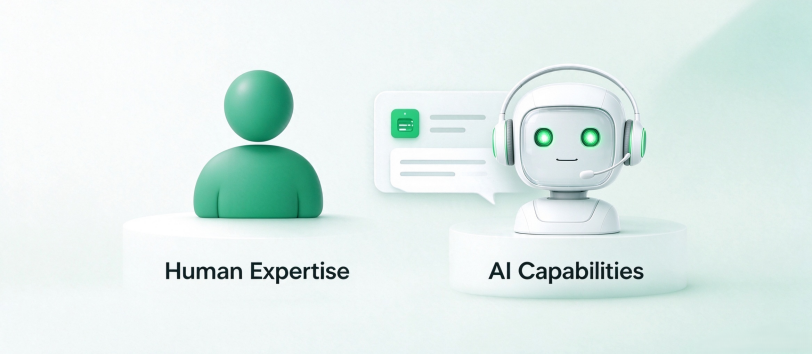
The strongest operating model does not force every customer into the same automated journey. It assigns work according to complexity, risk, and the type of help required.
AI can handle routine information retrieval, organize incoming requests, summarize previous conversations, and assist with approved workflows. Human agents can focus on exceptions, complaints, sensitive situations, and decisions requiring contextual judgment.
This division only works when the handoff is properly designed. When an AI agent escalates a case, it should pass along the conversation history, customer details available to the receiving team, the steps already attempted, and the reason for escalation. Customers should not have to explain the same issue again.
Businesses should also define clear escalation triggers. These can include an explicit request for a person, repeated unsuccessful answers, low confidence in retrieved information, policy exceptions, or signs of serious dissatisfaction. Financial and account-changing actions should follow their own authorization and confirmation requirements.
This is where customer service operations matter as much as the AI technology. Connected channels, consistent procedures, real-time quality monitoring, and human oversight help prevent automation from becoming another disconnected layer in the support process.
For businesses reviewing their broader operating model, our guide to customer service outsourcing services explains how external support operations can fit into customer service delivery.
Related guide: Consumer Electronics Customer Support Outsourcing: How AI + Human Operations Improve Customer Experience
Before selecting a platform or expanding an existing deployment, review five operational requirements.
Knowledge quality. Are product details, return policies, delivery rules, and troubleshooting instructions accurate, current, and consistent across channels?
System access. Can the agent retrieve the information needed for the task? Does it have only the permissions required to complete its assigned work?
Escalation ownership. Which team receives unresolved cases? How are urgent requests prioritized, and what happens outside normal operating hours?
Quality assurance. Are AI conversations reviewed for factual accuracy, policy compliance, inappropriate responses, and recurring failure patterns?
Operational accountability. Who updates the knowledge base, investigates repeated failures, adjusts workflows, and monitors customer outcomes after launch?
A platform can demonstrate impressive responses while failing these operational tests. Deployment readiness depends on the entire service process, not just the language model.
They can reduce waiting, provide consistent answers, retrieve relevant information, and support faster workflows. These benefits depend on accuracy, context, reliable integrations, and effective escalation when automation reaches its limits.
Customer service AI agents are systems designed to assist with or perform customer support tasks. Agentic AI emphasizes the ability to plan and execute multi-step tasks toward a goal, using tools and defined permissions. The terms overlap, and actual capabilities depend on implementation.
Evaluate the provider's ability to support real workflows, connect with existing systems, maintain knowledge accuracy, protect customer information, transfer cases to human agents, and report meaningful outcomes. Ask for a pilot using representative customer inquiries and assess resolution quality alongside operational cost.
Customer service AI agents are most useful when they remove repetitive work without making customer problems harder to solve. Businesses should begin with clearly defined workflows, connect AI to reliable information, restrict actions according to risk, and measure resolution rather than response speed alone.
The long-term advantage comes from combining automation with accountable customer service operations. AI can make support faster and more consistent, while human agents remain available when a situation requires judgment, flexibility, or a personal conversation.
Nexlence helps businesses bring AI-driven capabilities, omnichannel customer interactions, real-time insights, and human operations into a more coordinated customer service model. If your team is evaluating how to scale support without sacrificing service quality, explore Nexlence's customer service solutions to discuss an operating model aligned with your customer needs.

















 PREVOUS ARTICLE