
As user-generated content (UGC) explodes across social media, e-commerce, livestreaming, and short-video platforms, content moderation has stopped being a "nice to have" and become a core capability tied directly to platform reputation, user trust, and even regulatory survival. Once content volume reaches into the millions, more and more businesses are turning to content moderation outsourcing — handing this high-intensity, high-complexity work to a specialized third-party team.
So what exactly is content moderation outsourcing? What real value does it deliver? And how should a company choose the right partner? This article walks through all of it.
What Is Content Moderation Outsourcing?
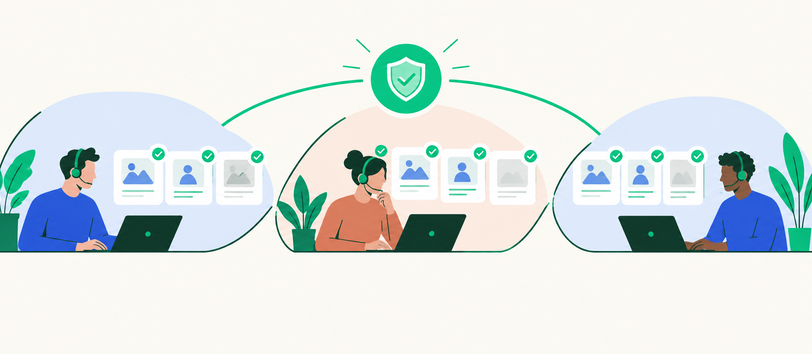
Content moderation outsourcing means delegating the review, classification, and enforcement of platform content — text, images, video, livestreams, and user profiles — to a third-party provider that acts according to a company's own community guidelines and platform policies. The goal is to catch harmful or policy-violating content before it ever reaches other users, while keeping content quality and compliance consistent at scale.
Companies typically choose outsourcing over building an in-house team for three core reasons: specialized expertise — moderators who already bring cross-cultural, cross-language judgment; elastic capacity — the ability to flex headcount up or down with content volume without absorbing recruiting and training costs internally; and reduced internal burden — freeing internal teams to focus on the core business instead of building and maintaining a moderation function from scratch.
In-House Team vs. Content Moderation Outsourcing: How Do They Compare?
|
Dimension
|
In-House Team
|
Content Moderation Outsourcing
|
|
Time to launch
|
Slower — requires hiring and training
|
Faster — can typically be stood up and running quickly
|
|
Cost structure
|
Fixed headcount + tooling investment
|
Pay-as-you-scale, more predictable costs
|
|
Handling volume spikes
|
Risk of over- or under-staffing across seasons
|
Flexes up or down on demand
|
|
Flexes up or down on demand
|
Limited by team size and locations
|
Global, distributed teams enable multilingual, round-the-clock coverage
|
|
Institutional expertise
|
Built from scratch, learning curve required
|
Reuses playbooks and calibration built across other platforms and industries
|
|
Internal resource load
|
Requires ongoing management attention
|
Internal team can focus on policy and core product
|
Why Manual-Only Moderation Is No Longer Realistic
In the early days of smaller platforms, manual review alone could keep up. But when a modern platform faces multilingual, multi-region content submissions in the millions per day, relying solely on human moderation simply isn't feasible — not just because of the sheer volume, but because the reputational and even existential risk grows sharply whenever moderation can't keep pace.
This is exactly why AI and automation tools have become embedded in moderation workflows. They typically handle three types of tasks:
- Identify — matching against known violation patterns, rule-based checks, or predictions from historical data to flag suspicious content or behavior in real time.
- Act — automatically taking pre-approved actions (reducing visibility, removing content, suspending an account) when content clearly violates policy.
- Escalate — routing ambiguous or borderline content to human moderators when it falls outside the model's confidence or training.
In short, AI excels at handling large volumes of clearly defined, repetitive moderation tasks. That not only improves efficiency, it also reduces how often moderators are directly exposed to disturbing content — a real protective benefit for the people doing the work.
Can AI Fully Replace Human Moderators?

The rise of generative AI has fueled excitement about the possibility of "fully automated" moderation — AI increasingly processes images and language in ways that resemble human understanding, which in theory could make moderation faster, cheaper, and more accurate. But in practice, AI moderation still runs into a few hard limitations:
Training data bias — If a model is trained predominantly on one language or region's data, its outputs can carry a corresponding cultural or geographic bias, making it harder to fairly serve a globally diverse user base.
Algorithm design limitations — Choices made in how a model weighs different inputs can unintentionally skew outcomes in favor of certain results, regardless of how balanced the training data itself is.
Limited explainability — Most AI systems are still "black boxes": they produce a decision without being able to clearly explain the reasoning behind it. That's a real problem for moderation, since a trustworthy content governance system needs to be able to explain why a piece of content was removed.
Regulatory pressure — Regulations such as the EU's Digital Services Act increasingly require platforms to demonstrate transparency and accountability in how content decisions are made. A fully automated, black-box process can actually introduce new compliance risk rather than reduce it.
That's why the best-practice approach isn't "replace humans with AI" — it's a hybrid model where AI handles scale and first-pass triage, freeing moderators from the most repetitive and disturbing content, while trained humans focus on nuance, cultural context, sarcasm, and other complex cases that require judgment rather than pattern-matching — along with final decisions and appeal reviews.
The Real Benefits of Content Moderation Outsourcing
Elastic scalability Content volume rarely grows in a straight line — a campaign, a holiday, or a viral moment can multiply review volume overnight. An outsourcing partner can flex capacity up or down with demand, so companies don't need to maintain a permanently oversized team just to handle peak periods.
Cost efficiency Building an internal moderation function means absorbing the cost of recruiting, training, tooling, and retention. Outsourcing typically converts that into a more predictable, transparent cost structure, freeing up budget and attention for the core business.
24/7, multilingual coverage With teams distributed across time zones, outsourcing enables round-the-clock review, ensuring users get consistent response times no matter where — or when — they post. That consistency is a real driver of user trust.
Cross-cultural judgment Mature outsourcing providers typically field multilingual, multicultural moderation teams that can more accurately interpret where the "violation line" sits in different regional contexts — reducing the misjudgments and appeal disputes that come from missing cultural nuance.
Best Practices When Choosing an Outsourcing Partner
Content moderation outsourcing isn't as simple as "handing off the work." Companies still need to stay closely involved in a few key areas:
1. Clear, continuously updated guidelines — Moderation rules need to stay aligned with a company's brand values and platform policy, and evolve as new risks and content formats emerge, backed by ongoing moderator training and performance evaluation.
2. Cultural sensitivity — Because UGC comes from diverse cultural backgrounds, moderation teams need the ability to recognize cultural nuance and avoid misjudgments caused by missing context.
3. Data privacy and security — Moderation often involves sensitive user information, so a partner must have data protection practices that comply with local regulations and prevent unauthorized access or misuse.
4. Moderator wellbeing — Prolonged exposure to sensitive, disturbing content is a real mental health challenge. A responsible provider should have dedicated wellness and support programs in place.
Frequently Asked Questions
Q1: Is content moderation outsourcing right for companies of every size?
Not necessarily. For early-stage platforms with lower content volume and relatively simple rules, a small in-house team may be sufficient. But as user base, language coverage, or content formats (like livestreaming or short video) expand, the scalability and expertise advantages of outsourcing become much more significant.
Q2: Does outsourcing mean giving up control over content governance?
No. In a mature outsourcing model, the platform still owns policy and rule-making, while the outsourcing partner executes against it. Both sides typically maintain alignment through regular reviews, QA sampling, and calibration checkpoints.
Q3: Are AI moderation and human moderation outsourcing mutually exclusive?
No — they're complementary. Most mature moderation programs use AI for large-scale first-pass triage and automated action on clear violations, while human moderators handle ambiguous, context-dependent cases. This hybrid model is widely recognized as the most effective approach today.
Q4: How do you evaluate whether a content moderation outsourcing provider is trustworthy?
Key things to check include: whether they offer customizable moderation rules and QA processes, genuine language and cultural coverage in the target markets, data privacy and security compliance, and whether they provide mental health support for their moderators.
Q5: Does content moderation outsourcing involve user privacy data, and how is it protected?
Yes, it often does. Moderators may be exposed to sensitive information users have posted, so data protection agreements, access controls, and regulatory compliance (such as adherence to local data protection laws) are essential things to verify when choosing a partner — not something to overlook in favor of price or speed.
Bringing It Together
Content moderation is both a technical discipline and a human one — AI delivers scale and efficiency, while human judgment provides the contextual understanding and accountability that can't be automated away. For platforms scaling across global, multilingual markets, finding an outsourcing partner that understands both the technology and the people behind it is essential to sustainable, long-term operations.
At Nexlence, this is work we do every day — building AI- and human-powered content moderation and trust & safety operations for platforms expanding across Southeast Asia, Latin America, the Middle East, and beyond, with multilingual coverage across English, Portuguese, Spanish, Russian, and more. If content governance scale, language coverage, or response time is a growing pain point for your platform, we'd be glad to talk through what a fit might look like.
Related guide: Content Moderation Outsourcing: Protect Your Brand Without Building an In-House Army
















 Nexlence
 PREVOUS ARTICLE