When was the last time you had to repeat your issue to a customer service agent – after you’d already explained it in an email or a live chat?
Perhaps it was last week. You sent an email, got no reply, tried the website chat, and the agent said “let me check” – then went silent. So you called, and had to start all over again on the phone. When you hung up, you probably
thought: this company doesn’t value my time.
You are not alone. Most consumers have had at least one experience where they had to repeat their problem across different support channels. And a large portion of them feel frustrated when that happens.
Customers don’t say “this brand’s email channel is broken” or “their live chat doesn’t work.” They simply say: “This brand’s service is terrible.”
That is exactly the problem that omnichannel customer support is
designed to solve. If you’re searching for this term, chances are you’re already thinking about: how do I stop
customers from repeating themselves across channels? What’s the real difference between omnichannel and
multichannel? What technology and services do I need? And where should I start?
This article will walk you through all of that – clearly and without jargon.
First, a Fundamental Distinction – Multichannel Is Not Omnichannel
Many brands believe they are already doing omnichannel because “we have phone, email, live chat, and social media.”
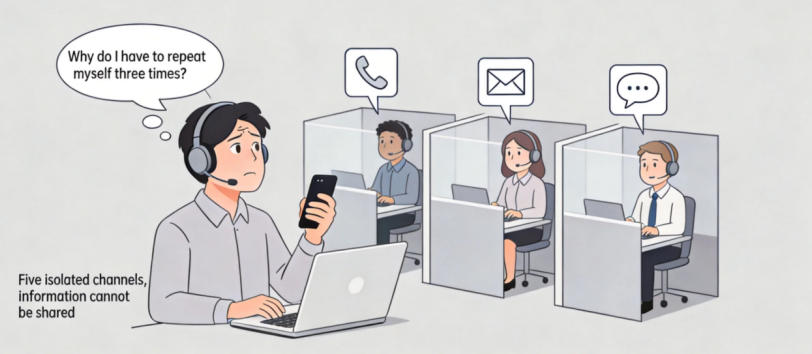
But that is multichannel – you have placed different windows in different places, but those windows do not talk to
each other.
Think of it this way: Multichannel is like five separate notebooks, one for each channel. The customer explains their
issue in the live chat notebook. Then they call, and the phone agent opens a completely blank notebook – so the
customer has to repeat everything.
Omnichannel is one shared notebook. No matter which channel the customer uses – phone, email, chat, WhatsApp,
Instagram DMs – every conversation is written in the same notebook. Any agent can open it and see the full context.
The customer never has to repeat themselves.
The difference is simple, but the experience it creates is worlds apart.
Why Omnichannel Customer Support Is No Longer “Nice-to-Have”
Customer behaviour has changed.
People no longer use just one channel to communicate with a brand. They might see a push notification on their phone
in the morning, browse products on their laptop at noon, ask a question on WhatsApp in the afternoon, and make a
call in the evening. For them, switching between these channels is natural and seamless – and they expect the brand
to be just as seamless.
When a brand fails to do that, customers don’t think “this channel isn’t integrated.” They think “this brand doesn’t
respect my time.”
The value of omnichannel customer support lies in transforming a negative experience – “I have to repeat myself” – into a positive one: “No matter where I come from, you already know me.”
Concretely, it delivers three levels of change:
For customers – no more repetition. One issue, one description, full tracking. Whether they
are on chat or on the phone, they feel they are talking to “one brand,” not being tossed between different
departments.
For agents – they don’t start from zero. When they pick up a call, the customer’s complete
interaction history is already on the screen. They don’t need to ask “Have you contacted us before?” – they
can say “I see you raised an issue on chat yesterday – let’s continue from there.” Agents become more
efficient and more fulfilled.
For the brand – higher customer retention. When customers feel understood and remembered, it
becomes harder for them to leave. Omnichannel isn’t just a service upgrade – it’s the infrastructure for
brand loyalty
What a True Omnichannel Customer Support Solution Should Include
There are many “omnichannel” solutions on the market, but the ones that actually work usually contain these five core
components:
1. All channels connect to the same “brain”
Live chat, phone, email, SMS, WhatsApp, WeChat, Instagram DMs – no matter where the customer comes from, everything
goes into a single system, not siloed separately.
2. One unified agent workspace
Agents don’t need to switch between a dozen tabs. One dashboard shows all channel conversations, full customer
history, knowledge base suggestions, and ticket status – all in one place.
3. Customer data is unified into a complete profile
Every interaction – whether an inquiry, a complaint, or a purchase – is recorded and linked to a single customer ID.
What the agent sees is not an isolated conversation but a whole person.
4. Intelligent routing
Based on issue type, agent skills, and current workload, conversations are assigned to the right person. Customers
don’t get angry because they’ve been transferred three times.
5. AI assists – but does not dominate
AI handles repetitive, routine questions (like “where is my order?”), and also provides real-time knowledge
recommendations and phrasing suggestions to human agents. AI is not here to replace people – it’s here to make them
better.
What to Look for When Choosing an Omnichannel Solution
With so many vendors out there, here are the key questions you should ask:
Is it truly omnichannel, or is the data still siloed?
Ask the vendor to demonstrate: a customer asks a question on chat, then calls in – can the phone agent see the chat
history? If not, it’s pseudo-omnichannel.
What can the AI actually solve?
Don’t just check “do you have a chatbot?” Ask: what percentage of routine issues can the AI resolve on its own? If it
can’t resolve them, can it hand off smoothly to a human? What real-time help does AI give to human agents?
If my customers are global, can you support them?
Which languages do you cover? Do you have local agent teams? How do you handle time zones? These are critical for
cross-border or global brands.
Are you selling software, or are you a partner who will walk with us?
Software vendors take your money and leave. A true partner will work with you on process design, system
configuration, team training, and ongoing optimisation.
What Nexlence Brings to the Table
Now that you understand the theory – who actually makes it happen?
That’s where Nexlence comes in. We are
not just a software company. We are an omnichannel customer support partner that combines AI efficiency with human
warmth, delivered by a global talent network.
Our approach is straightforward: AI handles the repetitive, standard stuff – like order status, return policies,
password resets – so that routine requests are resolved quickly at the front line. Our global team of
professionals takes care of what truly needs human connection – complex complaints, emotional situations,
relationship building – and they do it faster and more accurately with AI-assisted insights.
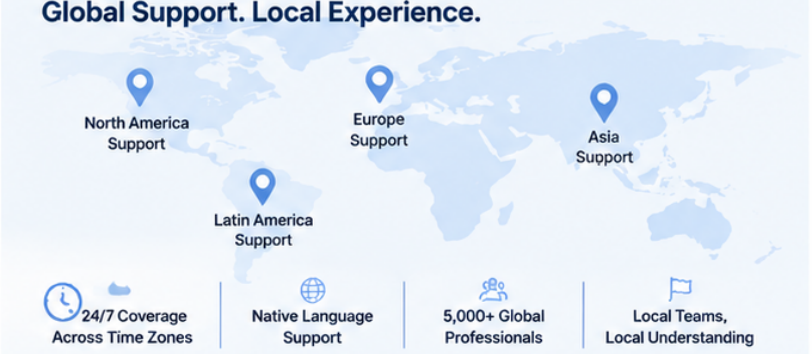
We have over 5,000 professionals worldwide, spread across multiple delivery centres (including our newest site in
Lima, Peru). This means if your customers are in North America, Europe, Latin America, or Asia, we can provide local
language and local time-zone support. When a customer calls, they hear a familiar accent and a voice that
understands their culture.
And we don’t sell and disappear. We will work with you to diagnose your current channel pain points, design a
customised omnichannel roadmap, and stay with you through implementation and continuous improvement. Our goal is to
eliminate channel silos – so that every customer, no matter which channel they use, feels they are talking to a
brand that truly remembers them.
Frequently Asked Questions
Q: Does omnichannel support require me to tear down my existing customer service system?
Not necessarily. Many solutions can be implemented in phases. You can start with the most urgent pain point – like
integrating chat and phone – and expand gradually.
Q: Is omnichannel suitable for small businesses?
Absolutely. The competition in customer experience does not care about company size. What matters is choosing a
solution that fits your scale, not chasing “big and comprehensive” from day one.
Q: Will AI make human agents obsolete?
No. AI does what AI is good at (repetitive, standard, high-volume tasks), and humans do what humans are good at
(complexity, empathy, relationships). The combination is the true shape of omnichannel.
Q: How long does it take to implement omnichannel support?
It depends on where you are and where you want to be. Some basic integrations can show results in weeks; a full
transformation may take several months. A good partner will help you set the right pace.
Conclusion
Every time a customer reaches out to you, they are giving you a chance to prove that you care.
Omnichannel customer support is not about technology – it’s about attitude. It sends a clear message to your
customers: We remember you. We value your time. We will not make you repeat yourself again and again.
If you want your customers – whether they reach you by phone, chat, email, or social media – to have a seamless,
remembered, and understood experience, Nexlence can help you achieve that.
Let’s talk about your current channel setup and your biggest pain points. No contract pressure – let us first
diagnose where you can improve the fastest. Bring us your challenges, and we’ll bring you a tailored plan and a
commitment to walk with you every step of the way.














 Nexlence


 PREVOUS ARTICLE