
Customer expectations rarely grow at the same pace as the teams serving them.
A business can start with a manageable volume of customer inquiries, disputes, and service requests. Then a new market opens, an e-commerce campaign takes off, or order volumes suddenly increase. The workload changes quickly. What worked six months ago may no longer be enough.
That is where enterprise CX solutions need to do more than handle today's ticket volume. They need to help businesses expand customer service capacity without constantly rebuilding their internal operations.
What Makes an Enterprise CX Solution Scalable?
Scale is not simply about adding more agents.
A scalable CX operation needs to handle higher volumes while maintaining response quality, consistent processes, and coverage across the channels customers actually use. It also needs to adapt when the nature of customer interactions changes.
For example, an international e-commerce business may face a sharp increase in order questions and payment disputes during a major sales period. A consumer electronics company may need multilingual customer service after entering several new markets. A growing DTC brand may need additional agents to manage customer conversations across multiple channels.
These are different operational challenges, but the underlying requirement is similar: customer service capacity needs to grow without placing all the pressure on the internal team.
Where Enterprise CX Operations Often Struggle
Growth can expose weaknesses that are difficult to see at smaller volumes.
An internal support team may manage everyday inquiries well but struggle when thousands of additional tickets arrive during a promotion. A company may have strong English-language support but lack enough agents to serve customers in other markets. Dispute handling can also become a bottleneck when every case requires additional time and attention.
The problem is not always a lack of capable employees. Sometimes there simply are not enough people available when demand changes.
Trying to solve every increase through internal hiring can also take time. Businesses have to recruit, train, schedule, manage, and retain additional customer service staff—even when demand may fluctuate later.
This is where outsourcing customer service operations can provide more flexibility.
Enterprise CX Solutions for High-Volume E-Commerce Support
E-commerce businesses often experience the biggest CX pressure when sales are going well.
More orders mean more delivery questions, refund requests, account issues, payment concerns, and disputes. During peak periods, even a well-organized internal team can become overloaded.
Nexlence provides customer service operations that can help businesses handle these increases in workload. Our teams can support customer inquiries, complaints, order-related questions, and other day-to-day service interactions, while dedicated specialists can handle dispute-related workloads.
The objective is straightforward: give businesses the customer service capacity they need without requiring the entire operation to be built internally.
Multilingual Customer Service for Cross-Border Growth
Expanding into a new market creates a customer-service requirement alongside the sales opportunity.
Customers expect to communicate in their own language, especially when an issue involves payments, delivery, returns, complaints, or account problems. As interaction volumes increase, maintaining consistent multilingual support internally can become difficult.
Nexlence operates a multilingual CX network covering English, Portuguese, Spanish, and Russian, supporting customer inquiries, disputes, and complaints across international markets.
More than 60% of Nexlence's volume comes from overseas operations, giving our teams substantial experience in supporting customers across different markets and languages.
Customer Service Operations Across Growing Channels
Customer conversations do not stay in one place.
Depending on the business, customers may reach out through email, chat, social media, or other service channels. As the number of channels increases, so does the operational work behind them.
A customer service outsourcing partner can take responsibility for the day-to-day management of these interactions, helping businesses maintain coverage as volumes grow.
For an enterprise with multiple markets or a large customer base, this can be more practical than continuously expanding an internal team for every new channel and region.
AI Should Support Customer Service Teams, Not Replace Them
AI can help customer service operations process information and manage repetitive workloads more efficiently. But not every customer interaction should be reduced to an automated response.
A complaint may require context. A dispute may involve several previous interactions. A customer with an unusual problem may need a person who can understand the situation and decide what to do next.
Nexlence focuses on AI + human collaboration, using AI where it can support operational efficiency while keeping human agents responsible for customer interactions that require judgment, communication, and problem-solving.
For enterprise CX operations, the value is not simply automation. It is using technology in ways that help customer service teams handle more work effectively.
Built for Larger Customer Service Operations
Nexlence has 1,600+ CX agents and 400+ specialists handling dispute tickets.
This gives businesses access to additional customer service capacity without requiring them to build every function internally.
The exact requirement varies from company to company. One business may need additional agents during seasonal peaks. Another may need multilingual customer service for overseas markets. An e-commerce company may require more capacity for customer inquiries and disputes.
The important point is flexibility. Customer service requirements change, and the operating model needs to change with them.
What Should You Look for in Enterprise CX Solutions?
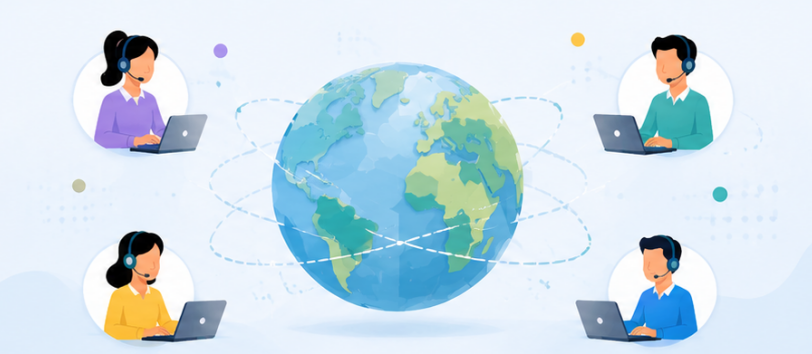
Before choosing an enterprise CX outsourcing partner, businesses should look beyond the number of agents available.
Consider how well the provider can handle your actual workload, including:
- Customer service volume: Can the operation handle seasonal or unexpected increases in inquiries?
- Market coverage: Can it support customers across the languages and markets you serve?
- Dispute handling: Are there experienced specialists for more complex customer cases?
- Channel coverage: Can the team support the channels your customers actually use?
- Operational flexibility: Can capacity be adjusted as your business changes?
- Human support: Is there a clear role for trained agents when automated processes are not enough?
The strongest fit is not necessarily the provider with the biggest operation. It is the one whose service model matches the way your business actually interacts with customers.
FAQ
How do you measure the success of an outsourced CX operation?
Success should be measured against the business objectives of the customer service program. Depending on the operation, useful indicators may include response times, resolution rates, customer satisfaction, service quality, ticket volumes, and adherence to agreed service processes.
Will outsourcing CX mean giving up control over customer service?
Not necessarily. A well-managed outsourcing model should work within the company's existing customer service processes, policies, and brand standards. The business can retain oversight of how customer interactions are handled while the outsourcing team manages the operational workload.
Can an outsourced CX team work with our existing processes?
Yes. Customer service outsourcing does not always require a business to completely change its existing operating model. The CX team can be trained around the company's products, policies, workflows, escalation procedures, and communication standards before handling customer interactions.
How quickly can an enterprise CX operation adapt to changes in demand?
The answer depends on the scope and complexity of the operation. A flexible outsourcing model can make it easier to adjust staffing capacity when customer volumes change, such as during seasonal campaigns, market expansion, or unexpected increases in service requests.
Is CX outsourcing suitable only for large enterprises?
No. The right question is whether the business has a customer service workload that would benefit from additional operational capacity or specialist support. Growing e-commerce businesses, DTC brands, retailers, and international companies may all consider outsourcing when internal resources become difficult to scale efficiently.
Conclusion
Enterprise CX solutions should be evaluated by what they allow a business to handle—not simply by the technology behind them.
When customer volumes increase, markets expand, or service requirements become more complex, businesses need customer service operations that can adjust without putting all the additional work on their internal teams.
Nexlence provides outsourced CX operations for businesses managing high-volume customer service, e-commerce inquiries and disputes, multilingual support, and growing customer interactions. With 1,600+ CX agents, 400+ dispute specialists, multilingual coverage, and AI + human collaboration, Nexlence helps businesses add customer service capacity where it is actually needed.
If your customer service operation is preparing for another stage of growth in 2026, talk with Nexlence about the workload you need to manage and the support structure that could fit it.
















 Nexlence




 PREVOUS ARTICLE