We use cookies to improve our site. By using or further navigating our site you accept our cookie policy.Please click here to check the Privacy Policy and Cookie Policy.



Smart
Empowerment

2026-09-14
 Nexlence
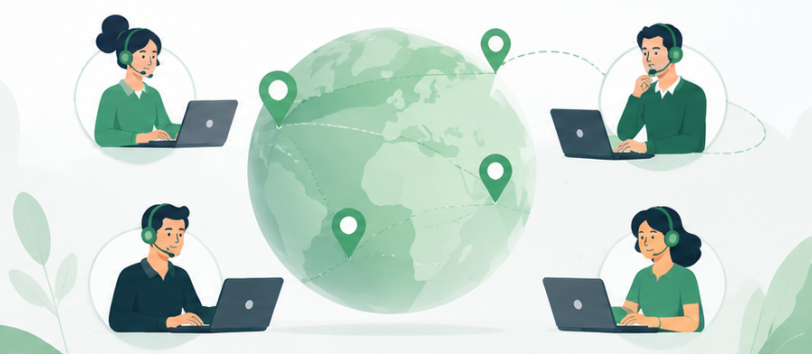
Imagine this: You're the founder of a fast-growing e-commerce brand. Your product is flying off the shelves, but your customer support team is drowning. Response times are stretching from hours to days. Customer satisfaction scores are sliding. Your international customers are frustrated by language barriers. You're losing sales—not because of your product, but because of how you're supporting it.
This is the point where customer support outsourcing becomes more than a cost-saving decision. The right outsourcing partner can help you increase coverage, improve response times, support new markets, and give your internal team room to focus on growth.
But with so many providers offering similar services, how do you determine which companies are truly among the best customer support outsourcing companies in 2026?
The answer goes beyond agent numbers or hourly rates. You need to evaluate technology, human expertise, multilingual capabilities, scalability, channel coverage, and the provider's ability to become a genuine extension of your customer experience team.
Customer support has evolved significantly. Businesses are no longer managing support through a single channel or serving customers within one geographic market. Customers may contact a brand through live chat, email, voice, social media, or other digital touchpoints—and they expect a consistent experience regardless of where the conversation begins.
At the same time, support volumes can change rapidly. Product launches, seasonal demand, international expansion, and unexpected service issues can all put pressure on internal teams.
This is why customer support outsourcing is increasingly viewed as a strategic growth tool rather than simply a way to reduce labor costs.
In 2026, leading outsourcing models are increasingly combining AI-powered automation with human expertise. AI can handle repetitive inquiries, support knowledge retrieval, improve workflow efficiency, and assist agents in real time. Human professionals can then focus on complex customer cases, complaints, disputes, order-related issues, product inquiries, and interactions that require judgment or empathy.
The result is a support operation that can scale without sacrificing the human side of customer experience.
So the real question is no longer simply whether you should outsource customer support.
It is which outsourcing partner can deliver the right combination of technology, people, flexibility, and customer experience capabilities for your business.
Not every outsourcing provider is built for the same type of business. A company serving a global e-commerce brand may need a very different operating model from a consumer brand managing high volumes of customer inquiries across multiple markets.
When evaluating potential partners, consider the following capabilities.
AI has become an important part of modern customer support, but the most effective model is not necessarily the one that automates the most interactions.
Instead, look at how AI is integrated into the entire support workflow.
AI can help classify inquiries, retrieve relevant knowledge, summarize conversations, recommend responses, automate repetitive requests, and identify patterns across large volumes of customer interactions.
Human agents remain essential when customers have complex questions, sensitive complaints, order issues, disputes, or situations that require judgment.
The strongest outsourcing models therefore use AI to make human teams more efficient rather than treating automation as a complete replacement for human support.
Today's customers expect to communicate with brands through the channels they already use.
That may include email, live chat, voice, social media, messaging platforms, and other digital touchpoints. International businesses also need to deliver these experiences across multiple languages.
However, simply offering several channels is not enough.
The better question is whether the provider can create a connected customer journey across those channels.
A customer who starts a conversation through social media and later moves to live chat should not have to repeat their entire situation to another agent.
This is where omnichannel customer support becomes valuable. By connecting customer information and interaction history, businesses can create a more consistent and less frustrating support experience.
Customer expectations are changing as younger digital-native consumers become an increasingly important part of the market.
Speed matters, but so do personalization, convenience, transparency, and authentic communication.
Customers increasingly expect brands to understand their context instead of forcing them through rigid scripts and repetitive processes.
For outsourcing providers, this means customer service training needs to go beyond basic response procedures. Agents need access to accurate knowledge, customer context, and the tools required to resolve issues efficiently.
The goal is not simply to respond quickly.
It is to make every interaction feel relevant and useful.
Global coverage is important for businesses operating across multiple markets, but geographic scale alone does not guarantee a good customer experience.
Customers in different regions may have different communication styles, expectations, purchasing behaviors, and service preferences.
The best customer support outsourcing companies combine global operational capabilities with local market understanding.
This allows businesses to maintain consistent brand standards while adapting the customer experience to individual markets.
Support demand rarely stays constant.
An e-commerce company may experience a major increase in inquiries during a seasonal campaign. A consumer brand may need additional support following a product launch. An international business may suddenly require coverage for a new market.
Your outsourcing partner should be able to adapt without compromising service quality.
Scalability should therefore be evaluated not only by the number of agents a provider can supply, but also by how quickly it can recruit, train, deploy, and manage additional resources when demand changes.
| Business Challenge | Nexlence Approach |
|---|---|
| Inconsistent customer experiences across regions | Tailored CX strategies aligned with specific business and market requirements |
| Growing multilingual support requirements | Multilingual and omnichannel customer support across key touchpoints |
| Increasing support volume | Flexible workforce models designed to scale with demand |
| Repetitive customer inquiries | AI-powered automation and intelligent workflows |
| Complex customer interactions | Human expertise for complaints, disputes, order-related issues, product inquiries, and other high-value cases |
| CX technology and workflow gaps | AI-enabled CX capabilities through the X-Force Platform |
| Global expansion | Distributed delivery capabilities combined with localized customer support |
| Difficulty maintaining service quality at scale | Structured training, quality management, analytics, and operational oversight |

Finding a suitable outsourcing provider starts with understanding your own support operation.
Before comparing providers, identify your average interaction volume, peak demand periods, primary support channels, required languages, service hours, and the complexity of customer inquiries.
Then evaluate potential partners against those requirements.
You do not necessarily need to outsource your entire customer service operation.
Some businesses outsource Tier 1 support while keeping complex or high-value customer cases in-house. Others outsource multilingual support, after-hours coverage, social media support, or seasonal overflow.
Defining the scope in advance makes it easier to compare providers and measure the results after implementation.
Your outsourcing provider should fit into your existing customer experience ecosystem.
Consider how the provider will work with your CRM, helpdesk, knowledge base, order management systems, analytics tools, and other platforms.
The smoother the integration, the easier it is for agents to access the context they need to resolve customer inquiries efficiently.
Do not judge an outsourcing partner solely by its number of agents or advertised service capabilities.
Ask how performance will be measured.
Relevant metrics may include first response time, first-contact resolution, customer satisfaction, resolution time, escalation rate, quality score, and cost per resolution.
These metrics provide a much clearer picture of whether an outsourcing partnership is actually improving your customer experience.
A provider may meet your current requirements but struggle when your business grows.
Ask how the provider handles increased ticket volumes, new markets, additional languages, seasonal peaks, and changes in customer demand.
The right partner should be able to grow with your business rather than forcing you to redesign your support operation every time demand changes.
The best providers combine AI-powered technology with human expertise, omnichannel and multilingual capabilities, flexible scalability, strong quality management, and global delivery capabilities. The right provider should also be able to adapt its operating model to the specific needs of your business.
Savings vary significantly depending on support volume, location, service complexity, technology requirements, and the scope of outsourcing. Cost should therefore be evaluated alongside performance metrics such as resolution rate, response time, customer satisfaction, and overall cost per resolution.
Not entirely. AI is increasingly being used to automate repetitive interactions, assist agents, retrieve information, analyze conversations, and improve workflows. Human professionals remain important for complex, sensitive, high-value, and customer-facing interactions that require judgment or empathy.
Choosing among the best customer support outsourcing companies in 2026 is not simply a matter of finding the lowest-cost provider.
The right partner should help you solve the problems that become harder as your business grows: increasing support volume, multiple customer channels, international expansion, language requirements, inconsistent service quality, and the growing need for faster and more personalized customer experiences.
In 2026, the strongest outsourcing models are increasingly built around a combination of AI-powered efficiency and human expertise.
AI can automate repetitive work and improve operational visibility, while experienced customer service professionals handle the situations that require judgment, empathy, and problem-solving. Combined with omnichannel support, multilingual capabilities, and flexible global delivery, this model gives businesses a more sustainable way to scale customer experience.
Nexlence brings these capabilities together through its AI-powered CX solutions, global talent network, multilingual operations, and omnichannel customer support model.
Whether you are dealing with rapidly increasing support volume, expanding into international markets, or looking for a more intelligent way to manage customer interactions, the right outsourcing strategy can turn customer support from an operational burden into a competitive advantage.
Ready to build a more scalable customer support operation?
Explore Nexlence's AI-powered customer experience solutions and discover how the right combination of technology, global talent, and human expertise can help your business deliver better customer experiences at scale.













 PREVOUS ARTICLE