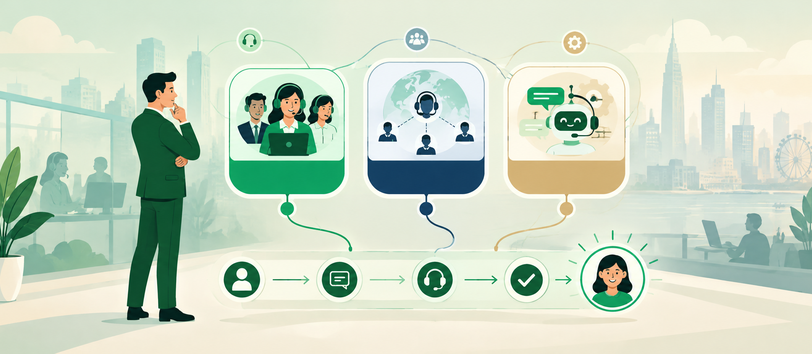
When businesses evaluate customer service outsourcing services, the question is no longer simply which provider offers the lowest hourly rate. In 2026, customer support outsourcing increasingly involves omnichannel coverage, AI-assisted operations, multilingual support, quality management, analytics, data security, and the ability to scale service capacity without damaging the customer experience. Companies comparing the best customer support outsourcing companies in 2026 therefore need to evaluate the operating model behind the price, not just the price itself.
Quick Answer
There is no single customer support outsourcing company that is objectively best for every business. The right provider depends on support volume, channels, geography, language requirements, product complexity, service hours, compliance requirements, and the level of control a company wants to retain.
For a meaningful comparison, businesses should examine service scope, delivery model, agent expertise, quality assurance, technology integration, scalability, reporting, security, and total cost, rather than relying on hourly rates or vendor size alone.
What Makes a Customer Support Outsourcing Company Competitive in 2026?
Customer support outsourcing has evolved beyond traditional call-center staffing. A modern provider may manage customer conversations across voice, email, live chat, social media, messaging platforms, and other digital channels while using automation and analytics to improve operational efficiency.
This matters because customer expectations are increasingly shaped by the entire interaction journey. A customer may discover a product through social media, ask a question through chat, receive an email follow-up, and later contact a voice agent. If these interactions are managed separately, the customer may need to repeat information multiple times.
A capable outsourcing partner should therefore be able to connect channels, processes, customer context, and escalation workflows rather than simply provide additional agents.
Deloitte Digital's 2026 Global Contact Center Survey also points to the changing role of customer service, reporting that customer service is increasingly treated as a growth-related function and that organizations with more mature AI capabilities reported substantially different profitability outcomes from lower-maturity organizations.
How to Compare Customer Support Outsourcing Companies
The most useful comparison starts with the operating model.
|
Evaluation Area
|
What to Examine
|
Why It Matters
|
|
Service Coverage
|
Voice, email, chat, social, messaging
|
Determines whether the provider can support the full customer journey
|
|
Delivery Model
|
Onshore, nearshore, offshore, hybrid
|
Influences cost, language coverage, time zones, and operational flexibility
|
|
Agent Model
|
Dedicated, shared, or hybrid teams
|
Affects product knowledge and consistency
|
|
Quality Assurance
|
QA scoring, monitoring, coaching
|
Helps maintain service standards at scale
|
|
Technology
|
CRM, help desk, AI, analytics
|
Determines how effectively support integrates with existing operations
|
|
Scalability
|
Hiring speed and capacity flexibility
|
Important during launches, seasonal peaks, and rapid growth
|
| Reporting |
SLA, CSAT, FCR, AHT, escalation data |
Makes outsourced operations measurable |
| Security |
Data handling, access control, compliance |
Critical when agents access customer information |
| Commercial Model |
Hourly, per contact, per resolution, dedicated team |
Determines the real economics of the engagement |
The key is to evaluate these factors together. A provider with a low hourly rate may become more expensive if the business needs extensive training, additional management, poor first-contact resolution creates repeat contacts, or the provider cannot handle peak demand.
Cost Should Be Compared With Total Cost of Service

Cost remains one of the strongest reasons companies consider outsourcing, but hourly pricing alone provides an incomplete picture.
Published 2026 pricing guides show broad ranges across delivery models. Offshore support can be available at roughly $8–$18 per hour in some markets, while nearshore and US-based models can be considerably higher. Other pricing models may charge per interaction, per resolution, or through a monthly dedicated-team arrangement.
That means two providers quoting the same hourly rate may still produce different total costs.
For example, Provider A may have a lower labor rate but require more management intervention. Provider B may have a higher rate but provide stronger QA, better reporting, lower repeat-contact rates, and better-trained agents.
A more useful calculation is therefore:
Total Cost of Service = Staffing + Management + Technology + Training + QA + Setup + Escalation + Rework
This is especially important when comparing enterprise providers with specialist CX outsourcing companies.
Global BPO vs. Specialist Customer Support Provider
Large global BPO companies can provide substantial infrastructure, multilingual delivery, geographic diversification, and large-scale workforce management.
However, a smaller specialist provider may offer a different operational model, particularly when a business needs more flexibility, dedicated teams, faster implementation, or closer collaboration with internal CX teams.
Neither model is automatically better. The appropriate choice depends on the complexity and scale of the program.
| Business Requirement |
Large Global BPO |
Specialist CX Provider |
| Very large agent volumes |
Often suitable |
May have capacity limits |
| Global geographic coverage |
Often extensive |
Depends on network |
| Highly customized workflow |
Depends on contract |
Often more flexible |
| Dedicated support team |
Available in many models |
Common |
| Rapid program changes |
Depends on governance |
Can be more flexible |
| Enterprise compliance |
Often extensive infrastructure |
Must be evaluated provider by provider |
| Specialized CX workflows |
Depends on specialization |
Often a core capability |
The Importance of Omnichannel Support
One of the biggest mistakes in vendor evaluation is treating phone support as the entire definition of customer service.
Modern support operations can involve multiple channels. A customer might ask a product question on social media, move to live chat for troubleshooting, and later receive an email containing instructions.
The outsourcing partner needs to understand how these channels interact.
For Nexlence, this is an important distinction between simply outsourcing customer contacts and building an integrated customer support operation. The objective is not merely to move tickets from one organization to another. The objective is to create a scalable operating layer that preserves customer context across channels.
Related guide:What Do Customer Experience Solutions Companies Actually Do?
AI Is Becoming Part of the Outsourcing Evaluation

AI is also changing how companies evaluate outsourcing providers.
The question is no longer simply whether a provider uses AI. Businesses should ask where AI is used and how human agents remain involved.
AI can support knowledge retrieval, intent classification, ticket routing, conversation summaries, agent assistance, quality monitoring, and automated responses. However, complex customer issues may still require human judgment.
A strong operating model therefore combines automation with human escalation rather than assuming that every customer interaction should be automated.
Questions to Ask Before Selecting a Provider
A serious vendor evaluation should move beyond sales presentations.
Ask how agents are trained, how quality is measured, how escalations are handled, what happens when volume suddenly doubles, how customer data is protected, and which performance metrics appear in monthly reports.
It is also useful to ask what happens when a customer contacts the company through multiple channels. If the provider cannot explain how customer context is preserved, the business may end up with a fragmented support experience.
FAQ
What are the best customer support outsourcing companies in 2026?
There is no universally best provider for every business. The appropriate choice depends on service scope, geography, support complexity, technology integration, scalability, security, and commercial structure.
How much does customer support outsourcing cost in 2026?
Published 2026 market guides show broad pricing ranges, with offshore support often costing considerably less than US-based support. Pricing can range from roughly single-digit dollars per hour to $40 or more depending on geography, specialization, and delivery model.
Should companies choose the cheapest outsourcing provider?
Price should be considered alongside service quality and total cost. A lower hourly rate does not necessarily mean a lower cost per resolved customer issue.
Is an offshore customer support provider suitable for enterprise businesses?
It can be. The decision depends on language requirements, customer expectations, compliance, security, support complexity, and the provider's management and QA capabilities.
What should businesses measure after outsourcing?
Common metrics include CSAT, first-contact resolution, response time, resolution time, SLA attainment, quality scores, escalation rates, and customer retention-related indicators.
Conclusion
Choosing among the best customer support outsourcing companies in 2026 requires a broader evaluation than comparing hourly rates. Businesses should examine how each provider combines people, technology, quality management, omnichannel support, analytics, security, and scalability.
The strongest outsourcing relationship is not necessarily the one with the lowest initial quote. It is the one whose operating model aligns with the company's customer expectations, growth requirements, and long-term CX strategy.
Sources
- Deloitte Digital, 2026 Global Contact Center Survey — research on customer service, AI maturity, and contact-center performance.
- CustomerExperience.io, Customer Service Outsourcing Cost and Pricing: 2026 — pricing models and cost considerations.













 Nexlence
 PREVOUS ARTICLE