We use cookies to improve our site. By using or further navigating our site you accept our cookie policy.Please click here to check the Privacy Policy and Cookie Policy.



Smart
Empowerment

2026-09-14
 Nexlence

A customer service problem rarely starts with customer service.
For an e-commerce company, it might begin with a sudden increase in orders. For a consumer electronics brand, it could be a new product launch that brings hundreds of questions from customers. For a global digital platform, it might be a spike in complaints that suddenly overwhelms the existing operations team.
The problem usually becomes visible when customers start waiting longer for replies, agents struggle to keep up, or different markets begin delivering noticeably different experiences.
At that point, many businesses start looking for a B2B customer experience solution. But choosing a CX partner based on a list of services alone can be a mistake.
Customer service for an e-commerce business is not operated in the same way as customer service for a smart home brand or a media platform. The channels are different. The interaction volumes are different. The conversations are different. Even the definition of a "good customer experience" can change from one industry to another.
What matters is finding a CX operation that fits the way your business actually interacts with customers.
Before comparing CX providers, it helps to look at where your customers are actually contacting you.
Are most conversations happening before a purchase? Are customers asking about orders and delivery? Are complaints concentrated on social media? Does your support volume rise sharply during promotions or product launches? Do customers in different countries expect service in different languages?
These questions reveal more than a generic service checklist.
They also explain why a CX model that works well for one company may create unnecessary costs or operational problems for another.
For some businesses, the priority is handling a large number of straightforward conversations quickly. Others need smaller teams of experienced agents who can manage more complicated customer relationships. International companies may need both at the same time.
The right approach starts with the operation you need to run—not the technology you happen to be offered.
E-commerce customer service has a rhythm of its own.
Interaction volumes can change dramatically around promotions, holidays, product launches, and unexpected delivery issues. Customers also tend to move quickly between pre-sales questions, order inquiries, returns, refunds, and complaints.
That puts pressure on both staffing and response times.
An effective CX operation for e-commerce typically needs strong coverage across:
Pre-sales inquiries
Order and delivery questions
Returns and refunds
Complaints and disputes
Social media customer service
24/7 support
Multilingual communication
Flexible staffing during peak periods
Nexlence supports e-commerce businesses with customer service and engagement operations across international markets. The focus is on giving businesses the people and operational capacity needed to handle customer interactions at scale, while AI can be used to support repetitive tasks and improve efficiency.
For a fast-growing e-commerce brand, that flexibility can be more valuable than simply adding another customer service tool.
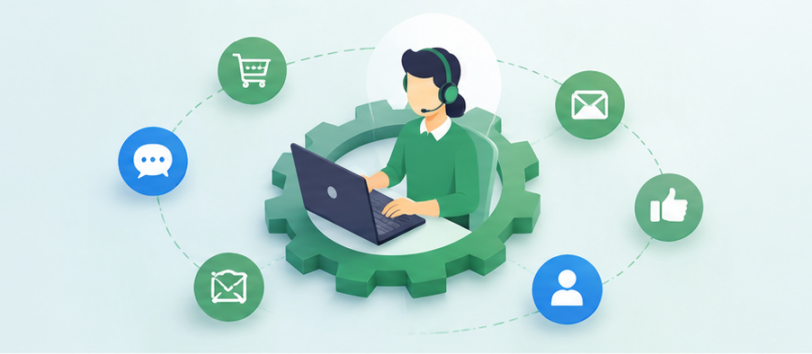
Consumer goods companies have a slightly different challenge.
Customers may discover a product through social media, ask questions before purchasing, contact the brand after delivery, and return later with a complaint or product-related question.
The customer sees one brand throughout that journey. They do not care which internal team owns each interaction.
That makes consistency especially important.
A capable CX operation can support customer inquiries, pre-sales communication, after-sales service, complaints, social media interactions, and customer engagement across channels.
Nexlence's consumer goods services are designed around these customer lifecycle interactions, combining customer engagement, omnichannel service, and AI-assisted operations.
The practical benefit is straightforward: your internal team does not have to manage every customer conversation themselves, while customers can still receive a consistent experience.
For consumer electronics brands, customer service often starts before the customer places an order.
Customers want to understand products, compare options, ask about availability, and clarify details before buying. After the purchase, the questions change to orders, returns, warranties, and other service-related issues.
This means the CX team needs to understand both the customer journey and the products it represents.
A strong operation can cover:
Pre-sales inquiries
Product-related questions
Order support
After-sales service
Complaint handling
Warranty-related communication
Multilingual customer service
The goal is not to turn every agent into a technical engineer. It is to make sure customers can reach a knowledgeable service team and receive clear, consistent answers throughout the buying and post-purchase journey.
Smart home products often create longer customer relationships than a simple transaction suggests.
Customers may need help understanding products before buying them, communicating about orders, or getting assistance after the purchase. They may also return to the brand through social media or other channels.
That makes customer service part of the overall product experience.
For smart home businesses, CX operations can include pre-sales inquiries, order-related communication, after-sales service, complaints, social media interactions, and multilingual support.
As these brands enter new markets, outsourcing can also provide additional customer service capacity without requiring the company to build a separate team in every market.
Media and entertainment businesses can generate very large volumes of user interactions, particularly on digital platforms.
The work may include customer service, user operations, content moderation, complaint handling, and community-related activities. The challenge is not only responding quickly. Quality and consistency have to hold up when the volume increases.
Nexlence's website highlights its work with a leading global short-video social platform across multiple international markets. The reported operation achieved 99.5% content review accuracy, covered more than 15 countries, and reduced user complaint rates by 40%.
This type of operation requires trained teams, clear processes, quality management, and the ability to scale resources when demand changes.
Manufacturing customer service tends to be less about huge numbers of individual conversations and more about the importance of each relationship.
Customers may need help with product inquiries, orders, service requests, complaints, or communication with different internal departments.
A delayed response can affect an ongoing business relationship, so reliability and process discipline matter.
For these companies, CX operations can include customer inquiry management, pre-sales communication, order-related service, after-sales support, complaint handling, and multilingual customer service.
The objective is to give customers a dependable point of contact while allowing internal teams to stay focused on production, engineering, sales, and other core responsibilities.

The details change from industry to industry, but several operational capabilities remain important.
| Capability | What It Means in Practice |
|---|---|
| Trained agents | People who understand the brand, products, processes, and customer expectations |
| Multilingual support | Service that works across languages and international markets |
| Omnichannel operations | Consistent customer service across the channels customers actually use |
| Flexible staffing | The ability to respond to seasonal or unexpected changes in volume |
| Quality management | Processes for monitoring and improving service performance |
| AI-assisted operations | Using AI to reduce repetitive work and help agents work more efficiently |
| Global delivery | Resources that can support customers across markets and time zones |
This is also where the difference between buying software and outsourcing CX becomes important.
Software can provide the infrastructure. It cannot, by itself, recruit and manage agents, handle customer conversations, monitor service quality, or take responsibility for the day-to-day operation.
For companies looking to outsource customer experience, the operating team behind the technology matters just as much as the technology itself.
Nexlence is built around customer experience operations rather than selling a standalone CX platform.
That distinction matters.
The company provides customer-facing teams and operational resources while using AI and digital capabilities to make those operations more efficient.
Nexlence has a global CX workforce of 1,600+ agents and 400+ specialists handling dispute tickets, supporting customer service and related operations at scale.
For businesses entering new markets or dealing with growing interaction volumes, this provides access to additional operational capacity without having to build every team internally.
International customer service requires more than translating a script.
Nexlence supports multilingual operations across languages including English, Portuguese, Spanish, and Russian, helping businesses communicate with customers across different markets.
This is particularly relevant for e-commerce, consumer brands, and other businesses with international customer bases.
Nexlence uses AI as part of its customer experience operations.
AI can help with repetitive customer interactions, agent workflows, quality management, and interaction analysis. Human agents remain responsible for conversations where context, judgment, and communication skills matter.
That balance allows businesses to pursue efficiency without turning customer service into an entirely automated experience.
Customers rarely stay in one channel.
A question might begin through live chat, continue through email, and later appear as a social media complaint.
Nexlence supports customer interactions across multiple channels, helping businesses manage these touchpoints as part of a broader customer journey.
Nexlence supports businesses in e-commerce, consumer goods, consumer electronics, smart home, media and entertainment, and smart manufacturing.
The advantage of this breadth is not that every company receives the same service package. It is that the CX operation can be shaped around different customer journeys and operational requirements.
The most useful way to evaluate a CX partner is to look at what changes for your internal team and your customers.
With Nexlence, businesses can gain:
More customer service capacity without building every team internally.
When interaction volumes grow, you can add operational resources without putting the entire burden on your existing customer service organization.
Global and multilingual coverage.
Customers in different markets can communicate with teams equipped to support their languages and local requirements.
More consistent customer interactions.
Training, processes, quality management, and operational oversight help reduce the differences that can appear when customer service is managed by disconnected teams.
Better use of AI without removing the human element.
AI can take care of repetitive work and assist agents, while people continue to handle conversations that require judgment and understanding.
A more manageable customer service operation.
Instead of coordinating multiple teams, markets, and channels internally, businesses can work with an external CX operation designed to manage those responsibilities at scale.
There is no reason to choose a provider simply because it offers the largest number of services.
Start with your own operation.
Look at your busiest customer service channels. Identify the types of conversations taking up the most agent time. Check where response times are slipping. Then look at whether your current team can realistically support the next stage of growth.
From there, ask potential providers:
Can you support our peak customer service volumes?
Can you provide the languages our customers need?
How do you train agents for our brand and industry?
How do you monitor service quality?
Which customer service activities can you take over?
How is AI used to support agents and operations?
Can the operation expand as we enter new markets?
These questions will tell you much more than a generic list of CX features.
AI can support agents and operations by handling repetitive tasks, assisting workflows, monitoring quality, and analyzing customer interactions. It works best when combined with human teams that can manage complex or sensitive conversations.
Yes. Nexlence provides multilingual CX operations, with capabilities including English, Portuguese, Spanish, and Russian, alongside its global delivery network.
Nexlence supports industries including e-commerce, consumer goods, consumer electronics, smart home, media and entertainment, and smart manufacturing.
There is no universal answer to which CX solution is best. The right model depends on your customers, interaction volumes, channels, markets, languages, and internal capacity.
One business may need to scale e-commerce support during peak periods, while another may need multilingual customer service or broader support covering customer service, user operations, and content moderation.
That is why a B2B customer experience solution should be evaluated as an operating model, not just a technology purchase.
Nexlence combines customer service teams, global delivery resources, multilingual capabilities, omnichannel operations, and AI-assisted workflows to help businesses manage CX at scale—giving internal teams more room to focus on core business while maintaining a consistent customer experience.
If customer interactions are growing faster than your team can handle, entering new markets requires additional language support, or agents are spending too much time on repetitive work, it may be time to rethink your CX operation.
Nexlence can help build an outsourced CX operation around your customers, markets, languages, channels, and growth plans—so your customer service can scale without losing the consistency, responsiveness, and human touch customers expect.













 PREVOUS ARTICLE