
When customer inquiries start growing faster than your internal team can handle, adding more employees is not always the fastest answer. Many businesses eventually turn to customer service outsourcing services to expand support capacity without building every operational function internally.
However, knowing that you need to outsource customer support services and knowing how to do it successfully are two very different things.
A poorly planned transition can create inconsistent answers, long onboarding periods, frustrated customers, and a support team that feels disconnected from your business. A well-planned outsourcing model, on the other hand, can help you add capacity while maintaining control over quality, customer experience, and brand standards.
So, how do you actually outsource customer support services?
Step 1: Identify What Is Creating Pressure on Your Support Team
The first step is not choosing a provider. It is identifying the operational problem you are trying to solve.
For some businesses, the problem is simply volume. Ticket numbers have increased, but internal staffing has not kept pace. For others, the challenge may be more specific. They may need support outside normal business hours, additional language coverage, or help managing seasonal demand.
These situations require different outsourcing models.
For example, a company experiencing occasional peaks may not need to transfer its entire support operation. It may only need overflow capacity during major promotions or busy seasons. A global business entering new markets may instead need multilingual teams that can support customers across different regions.
Before outsourcing, businesses should clearly understand which conversations are difficult to manage internally and why.
This prevents a common mistake: outsourcing everything simply because the existing team is overwhelmed.
The better approach is to define exactly where an external team can create the greatest operational value.
Step 2: Decide Which Customer Support Functions to Outsource
Outsourcing does not have to mean giving an external provider complete control over customer service. Businesses can outsource a specific channel, a particular customer segment, or a defined stage of the support process.
For example, routine inquiries through email and chat may be handled by an outsourced team, while complex complaints remain with an internal escalation team. Another company may keep weekday support in-house but outsource after-hours coverage.
The right outsourcing scope depends on the type of customer interaction, its complexity, and how closely it needs to be connected to your internal team.
| Customer Support Function | Suitable for Outsourcing? | Why |
|---|
| Email & Chat Support | Yes | Common inquiries can be handled through standardized processes and knowledge resources. |
| After-Hours Support | Yes | An outsourced team can extend service coverage without requiring a larger internal night-shift team. |
| Seasonal Support | Yes | Flexible external capacity can help manage temporary increases in customer inquiries. |
| Multilingual Support | Yes | External teams can provide language coverage when internal resources are limited. |
| Routine Order & Account Questions | Yes | Repetitive inquiries can often be managed efficiently with clear workflows and training. |
| Complex Complaints & Escalations | Sometimes | These cases may require closer coordination with internal teams and clearly defined escalation rules. |
| High-Risk or Highly Sensitive Cases | Depends | Businesses should determine whether these interactions require internal handling based on their policies and operational requirements. |
Highly repetitive inquiries are often easier to transfer because processes can be clearly documented. More complex conversations require stronger product knowledge, escalation rules, and closer collaboration with internal teams.
This is also where many modern customer service outsourcing services become more flexible than traditional call center models. The goal is not simply to move tickets from one team to another. It is to determine which parts of the operation should remain internal and which can be managed externally.
Step 3: Define Your Customer Support Requirements Before Contacting Providers
Once the outsourcing scope is clear, the next step is defining what the external operation actually needs to deliver.
A provider cannot build an effective support operation around a vague request such as "we need more agents."
The operational requirements should explain what customers need and what the outsourced team must be able to handle.
This may include the channels customers use, expected service hours, language requirements, typical inquiry types, expected volume, and escalation procedures.
Businesses should also consider future growth rather than defining requirements only around today's workload.
If international expansion is part of the plan, for example, choosing a model that can later support additional languages may be more practical than rebuilding the operation when the business enters a new market.
The goal is to create a support model that solves today's capacity problem without creating another operational bottleneck six months later.
Step 4: Prepare Your Knowledge and Processes for the Transition

One of the biggest reasons outsourcing transitions struggle is not necessarily poor agent performance.
It is missing information.
External teams need to understand how the business handles common customer situations. If policies, product information, escalation rules, and service standards exist only in the minds of internal employees, training becomes much harder.
Before launch, businesses should organize the knowledge needed to support customers consistently.
This does not mean creating an enormous training manual. It means ensuring that the outsourced team has clear answers to the questions customers ask most often and knows what to do when an issue cannot be resolved immediately.
Strong knowledge management also becomes increasingly important as products, policies, and promotions change.
An outsourcing relationship should therefore include a process for keeping operational knowledge current rather than treating onboarding as a one-time event.
Step 5: Build a Training Model Around Real Customer Conversations
Generic customer service training is not enough.
Agents may understand how to communicate professionally, but they still need to understand your specific business.
The most effective onboarding process uses real customer scenarios. Agents should learn how customers typically describe problems, which issues require escalation, what information must be verified, and where flexibility is appropriate.
Training should also include the company's communication style.
Customers should not feel that they are suddenly speaking to a completely different organization simply because the conversation is being handled by an outsourced team.
This is why businesses should view the external operation as an extension of their customer support function rather than simply additional headcount.
Step 6: Start With a Controlled Launch
Moving every customer interaction to a new provider at once creates unnecessary risk.
A controlled launch gives both teams the opportunity to identify operational gaps before support volume becomes too large.
The initial scope might focus on one channel, one market, or a specific category of inquiries.
During this period, businesses can examine whether training materials are sufficient, whether escalation paths work properly, and whether customers are receiving consistent answers.
The purpose of the initial launch is not to prove that outsourcing is perfect from day one.
It is to build a stable operating model before expanding it.
Step 7: Measure Quality, Not Just Volume
A growing support operation can process more tickets while still creating a worse customer experience.
That is why performance management should go beyond the number of conversations handled.
Businesses need visibility into whether issues are being resolved correctly, whether customers are receiving consistent information, and whether complex cases are being escalated appropriately.
Response speed matters, but a fast incorrect answer is not a successful interaction.
Quality management should therefore connect operational performance with the actual customer experience.
As the outsourced operation grows, these insights can also reveal larger business problems. Repeated questions about the same issue may indicate unclear product information, confusing policies, or a problem elsewhere in the customer journey.
Step 8: Create a Long-Term Model for Scaling
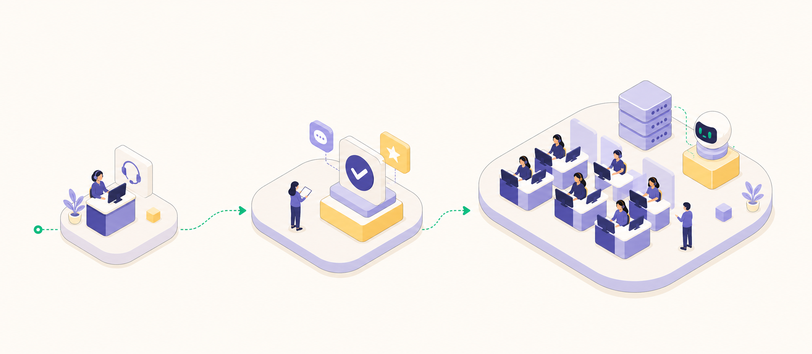
Outsourcing should not remain a temporary response to an overloaded support team.
Once the operation is stable, businesses can evaluate where additional capacity or technology can improve performance.
AI and automation can handle parts of the support journey that do not always require human intervention, while trained agents can focus on conversations involving judgment, empathy, or more complex problem-solving.
This combination allows businesses to scale more intelligently than simply adding agents whenever customer volume increases.
The strongest model is not necessarily the one with the largest team.
It is the one that directs customer inquiries to the right resource at the right time.
How Nexlence Supports Customer Support Outsourcing
Nexlence combines AI-enabled customer experience capabilities with human operational teams to support businesses managing customer interactions across multiple channels and markets.
Its customer contact services include omnichannel support, multilingual operations, and 24/7 global delivery capabilities. AI can support workflows and routine interactions, while human teams remain important for conversations that require judgment and a more complex level of support.
For businesses looking to grow support capacity, the outsourcing model can therefore be structured around the actual operational challenge rather than treating every customer interaction in exactly the same way.
Related guide: Call Center BPO Services: A Guide to Choosing the Right Customer Support Partner
FAQ
What is the first step when outsourcing customer support services?
The first step is identifying the specific support problem you want to solve, such as growing ticket volume, limited service hours, seasonal demand, or the need for multilingual support.
Can I outsource only part of my customer support?
Yes. Businesses can outsource specific channels, service hours, inquiry types, or overflow capacity while keeping other customer service functions in-house.
How long does it take to outsource customer support services?
The timeline depends on the complexity of the operation, including product knowledge, number of channels, languages, training requirements, and system processes. A controlled launch is often useful before expanding the full scope.
How do I maintain quality when outsourcing customer support?
Quality depends on clear training, updated knowledge resources, defined escalation procedures, and ongoing performance monitoring rather than simply measuring the number of tickets handled.
Conclusion
To outsource customer support services successfully, businesses need more than a provider and a group of agents.
They need a clear scope, organized knowledge, effective training, controlled implementation, and continuous quality management.
The right approach allows outsourcing to become part of a broader growth strategy. Instead of rebuilding an internal support organization every time demand increases, businesses can develop a more flexible operation that expands with customer needs.
















 Nexlence





 PREVOUS ARTICLE