We use cookies to improve our site. By using or further navigating our site you accept our cookie policy.Please click here to check the Privacy Policy and Cookie Policy.



Smart
Empowerment

2026-09-21
 Nexlence
To outsource customer support services, a business should first identify which support tasks need external assistance, define measurable service requirements, evaluate potential providers, and establish a controlled transition process. The right outsourcing model should improve service capacity and consistency without weakening customer relationships or operational visibility.
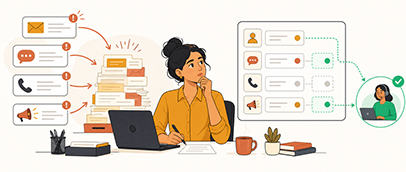
A growing business often reaches a point where customer support becomes difficult to manage internally. Orders increase, customers expect faster responses, and support requests arrive through more channels than the original team was designed to handle.
At first, hiring a few more agents may appear to solve the problem. But as demand grows, the business may face higher staffing costs, inconsistent response quality, limited coverage across time zones, and increasing pressure on internal managers.
This is where customer service outsourcing services become relevant. Outsourcing can give a company access to trained service teams, operational support, and additional capacity without requiring every function to be managed internally.
However, outsourcing customer support is not simply a matter of transferring emails or chat tickets to another company. The real challenge is deciding what to outsource, how the work should be managed, and how the business will determine whether the partnership is delivering meaningful results.
Before contacting an outsourcing provider, a company should understand the actual problem behind its support workload.
A business may be receiving more tickets than its internal team can process. Another company may have sufficient ticket-handling capacity but lack multilingual agents or coverage outside normal working hours. Some businesses may struggle with seasonal demand, while others need to improve service consistency across several markets.
These situations require different outsourcing arrangements.
For example, a retailer experiencing a major increase in order-related inquiries may need additional email and chat agents. A software company expanding internationally may require multilingual customer service. A consumer electronics brand may need a more structured process for warranty inquiries, product questions, and post-purchase support.
The first step is therefore to examine the current operation rather than immediately selecting a vendor.
| Business problem | Potential outsourcing requirement | Important consideration |
|---|---|---|
| Ticket volume exceeds internal capacity | Additional customer service agents | Ability to scale during demand peaks |
| Customers need support outside business hours | Extended-hour or 24/7 coverage | Shift planning and escalation procedures |
| Business is entering new markets | Multilingual customer support | Language quality and local communication |
| Service quality varies between agents | Standardized support operations | Training, QA, and performance monitoring |
| Internal team spends too much time on repetitive questions | Tier-one support or assisted automation | Knowledge base quality and escalation rules |
| Seasonal demand creates staffing pressure | Flexible support capacity | Contract flexibility and ramp-up speed |
A clear diagnosis helps prevent a common outsourcing mistake: purchasing a broad service package when the company only needs a specific operational function.

Not every customer-facing activity needs to be outsourced at the same time.
Some businesses begin with repetitive inquiries, such as order status, delivery questions, account information, or basic product guidance. Others outsource a complete support channel, such as live chat or email support. More mature operations may use an external partner to manage several channels while internal teams retain responsibility for complex cases and strategic customer relationships.
The decision should depend on the complexity, sensitivity, and business importance of each task.
For instance, an external team may handle routine order inquiries while internal employees manage major account complaints or sensitive commercial decisions. In another model, an outsourcing partner may handle the entire first-line support process and transfer unresolved cases to a specialist team.
The important point is to establish clear ownership.
A useful outsourcing scope should explain which requests the external team can resolve independently, which situations require approval, and which cases must be escalated immediately.
Without these boundaries, agents may either escalate too many cases or attempt to resolve issues beyond their authority.
A provider should not be evaluated only according to its hourly rate or the number of agents it can supply.
The more important question is whether the provider can meet the operational requirements of the business.
For example, a company should determine its expected response times, service hours, supported channels, language requirements, escalation process, and quality expectations before requesting proposals.
The following table illustrates the type of information that should be included in an outsourcing brief.
| Requirement | Example of what to define |
|---|---|
| Support channels | Email, live chat, social messaging, voice, or ticketing |
| Service hours | Business hours, extended hours, or continuous coverage |
| Languages | Required languages and acceptable proficiency |
| Response expectations | First-response and resolution targets |
| Case ownership | Which issues agents can resolve independently |
| Escalation | When and how cases move to internal specialists |
| Quality assurance | Review process, evaluation criteria, and reporting |
| Data handling | Access permissions, security procedures, and retention rules |
| Performance reporting | Volume, response time, resolution, CSAT, and backlog |
These requirements also make provider comparisons more meaningful. A low-cost provider that cannot support the required languages or operating hours may create additional costs later.

A customer support outsourcing provider is not simply a source of additional labor. It becomes part of the customer experience operation.
That means the evaluation should cover more than staffing availability.
A company should examine how the provider recruits and trains agents, manages quality, handles peak demand, and communicates operational problems. It should also understand whether the provider can work with the company’s existing customer service platforms and internal workflows.
Technology is another important consideration. Some providers rely primarily on human agents, while others combine agents with AI-assisted tools, automated workflows, knowledge management, and real-time performance monitoring.
Neither model is automatically suitable for every business. The appropriate choice depends on the type of customer inquiries, the complexity of the products, and the level of human involvement customers require.
For example, automated assistance may help agents locate information faster, while human representatives remain responsible for complex or emotionally sensitive interactions.

Moving customer support to an external provider all at once can create unnecessary risk.
A phased transition allows the business to test the provider’s operational capabilities before transferring a larger volume of customer interactions.
During the initial phase, the provider may handle a limited group of inquiries, a single support channel, or a defined market. Internal managers can then compare the results against existing performance data.
This stage should examine not only how many tickets are resolved, but also whether the answers are accurate, whether customers need to contact the company again, and whether escalations are handled correctly.
A successful transition requires more than process documents. Agents need access to accurate product information, clear response guidelines, and a reliable escalation structure.
The company should also identify a person responsible for coordinating the transition. Without clear internal ownership, communication gaps may appear between the outsourcing team, product specialists, and management.
Cost is often one reason companies outsource customer support services, but it should not be the only measure of success.
A provider that reduces staffing costs while increasing repeat contacts or customer complaints may not create meaningful business value.
Instead, the company should examine a balanced set of operational and customer experience indicators.
| Metric | What it helps evaluate |
|---|---|
| First response time | How quickly customers receive an initial reply |
| Resolution time | How efficiently issues are brought to a conclusion |
| First-contact resolution | Whether customers receive a solution without repeated contact |
| Customer satisfaction | How customers evaluate the support experience |
| Reopen rate | Whether supposedly resolved cases return |
| Backlog volume | Whether unresolved work is accumulating |
| Quality assurance score | Whether agents follow required service standards |
| Cost per contact | The operational cost of handling support demand |
These metrics should be interpreted together. A faster response time is useful, but not if agents provide incomplete answers. Similarly, a lower cost per contact may be misleading if the provider resolves only simple cases while complex requests remain unresolved.
Outsourcing should not be treated as a project that ends after the provider takes over daily operations.
Customer expectations, products, markets, and support volumes continue to change. A process that works during the first few months may need adjustment later.
Regular performance reviews can help identify recurring customer problems, training gaps, and opportunities to improve workflows.
For example, if customers repeatedly ask the same product question, the business may need to improve its knowledge base or product communication. If agents frequently escalate delivery issues, the company may need to improve coordination between customer service and logistics.
This is where an outsourcing partner can contribute beyond ticket handling. By combining operational data with human service experience and technology-assisted analysis, the support operation may identify patterns that are difficult to see from individual tickets.
Nexlence approaches customer experience through a combination of AI-enabled capabilities and human operations.
Its digital customer experience model connects customer interactions across channels such as websites, applications, social platforms, messaging, and customer service touchpoints. This approach can help businesses coordinate customer interactions while using technology and human expertise according to the needs of each service process.
For businesses evaluating outsourcing, the important question is not simply how many interactions a provider can handle. It is whether the provider can support consistent operations, maintain service quality, and adapt as customer requirements change.
Related guide:What Do Customer Experience Solutions Companies Actually Do?
It can be suitable when a business needs additional service capacity but does not want to build a large internal team. The appropriate model depends on ticket volume, service complexity, budget, and the level of control the business needs to retain.
Common activities include email support, live chat, order inquiries, account assistance, basic product questions, multilingual support, and first-line ticket handling. More complex tasks may require additional training or specialist escalation.
The company should establish clear service standards, provide accurate knowledge resources, review sample interactions, monitor customer feedback, and maintain regular communication with the provider.
No. Outsourcing may also provide access to additional staffing capacity, multilingual capabilities, extended service hours, structured quality assurance, and technology-assisted operations.
The timeline depends on the number of channels, languages, processes, systems, and agents involved. A limited pilot generally requires less preparation than a complete transition across multiple markets.
Learning how to outsource customer support services begins with understanding the business problem rather than choosing a provider based only on price.
A successful outsourcing model should define the right scope, establish measurable service requirements, prepare agents properly, and maintain visibility into customer experience performance.
When external teams, internal specialists, and technology work within a clearly managed operating model, outsourcing can become more than a staffing solution. It can support sustainable customer service operations as the business grows.
Gartner, Market Guide for Customer Service and Support Outsourcing Providers, April 30, 2026.
Gartner, Create Outsourcing Partnerships That Drive CX Results.












 PREVOUS ARTICLE