We use cookies to improve our site. By using or further navigating our site you accept our cookie policy.Please click here to check the Privacy Policy and Cookie Policy.



Smart
Empowerment

2026-10-10
 Nexlence

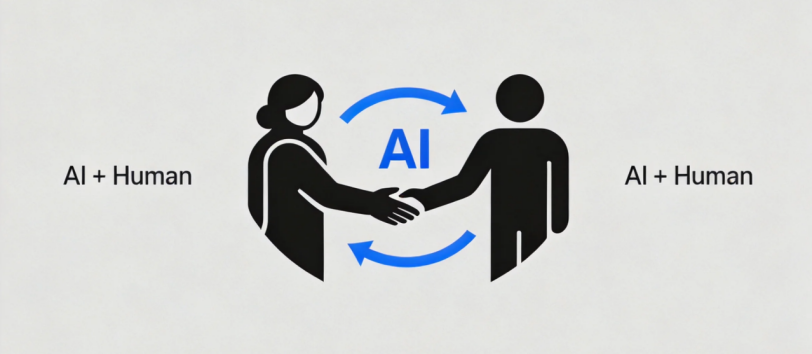
Quick Answer: Next-generation business process outsourcing customer service is increasingly built around an AI-plus-human operating model rather than a choice between automation and agents. AI can help classify conversations, surface customer information, assist with routine responses, and identify issues that need attention. Human agents remain responsible for conversations that require context, judgment, empathy, or accountability. The value of the model is not simply that AI handles more tickets. It is that agents can spend more of their working time on the interactions where human involvement actually matters.
For companies evaluating customer service outsourcing services, this changes what should be evaluated in a BPO partner.
The question is no longer simply how many agents a provider can supply or how quickly those agents can answer tickets. Businesses also need to understand how technology changes the work performed by those agents, where human decisions remain necessary, and how the provider controls quality when AI becomes part of the workflow.
A useful hybrid model does not put AI and human agents into separate camps.
AI supports the operation. People remain responsible for the customer relationship.

AI is particularly useful when a support operation has a large amount of information to process but does not require a human decision at every step.
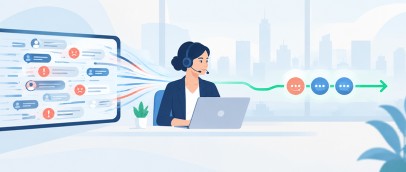
Incoming conversations can be classified and routed according to topic, urgency, or customer type. Common questions can be matched with relevant information. An agent can receive a summary of previous interactions rather than searching through multiple records before responding. Draft responses can provide a starting point for routine inquiries, while quality tools can identify conversations that may require additional attention.
These applications have something in common: they reduce the amount of manual work surrounding a customer interaction.
That distinction matters.
If an agent previously spent several minutes finding an order record, reviewing previous messages, and composing a routine response, AI assistance can reduce that preparation time. The agent can then spend more attention on the part of the conversation that actually requires human judgment.
The benefit is therefore not necessarily fewer people answering customers.
It can be a different use of the same human capacity.
Related guide: AI Driven Customer Experiences: How AI Is Transforming the Future of Customer Experience

Traditional customer service operations often require agents to spend part of every interaction searching, copying information, checking policies, and documenting what happened.
A more technology-supported operation can move some of that work into the background.
That gives agents more room to handle situations where following the standard answer is not enough.
Consider a customer whose order is late.
If the customer simply wants to know the latest delivery status, retrieving the relevant information is relatively straightforward.
But suppose the same delayed order is for a time-sensitive event, the customer has already contacted support twice, and the company previously promised a specific delivery date.
The problem is no longer just "Where is the package?"
The agent needs to understand the history of the interaction, recognize why the customer is frustrated, determine what options are actually available, and decide whether the situation should be escalated.
AI can help surface that context.
It does not automatically make the judgment.
The most useful AI applications in outsourced customer service tend to sit around the customer conversation rather than replacing every conversation.
| Customer Service Activity | Appropriate Role for AI | Human Role |
|---|---|---|
| Ticket classification | Categorize and route inquiries | Review exceptions |
| Customer history | Surface relevant records and summarize interactions | Interpret the context |
| Routine questions | Suggest or generate a response | Review when needed |
| Knowledge retrieval | Find relevant policies or product information | Apply information to the situation |
| Conversation monitoring | Identify patterns or potential escalation | Decide what action to take |
| Quality review | Analyze large numbers of interactions | Investigate and coach |
| Complex complaints | Provide background information | Lead the conversation |
| Retention situations | Surface customer history and relevant information | Handle the relationship and decision |
This is where the hybrid model becomes more practical than the simple idea of "AI replacing customer service agents."
AI can process information at a scale that is difficult for people to match manually.
Human agents can interpret situations where the correct response depends on circumstances rather than a single predefined answer.
One of the less obvious effects of AI in BPO customer service is the change in how agent capacity is used.
Suppose an agent handles 100 conversations during a shift. Those conversations do not all require the same amount of human effort.
Some may involve a simple order-status question. Others may require several messages, investigation, coordination with another team, or careful handling of a complaint.
If technology reduces the administrative work associated with simpler conversations, the agent has more capacity available for the difficult ones.
That can change the way a BPO operation is staffed and managed.
Instead of viewing every ticket as an equivalent unit of work, the operation can distinguish between interactions that require information processing and interactions that require human judgment.
This is a more meaningful way to think about AI-assisted customer service than simply counting how many conversations a chatbot can answer.
There are customer service interactions where automation can be highly effective.
Routine order-status questions, basic product information, simple policy explanations, and other predictable requests can often follow clearly defined processes.
The difficulty increases when the customer's problem does not fit neatly into one of those processes.
A customer may be angry because a previous promise was not kept. A refund request may involve an unusual circumstance. A long-term customer may expect the company to recognize the history of the relationship. A complaint may reveal a problem that the company itself needs to investigate.
In those cases, the quality of the response depends partly on judgment.
A system can provide information to the person handling the conversation, but the responsibility for deciding how to respond may still belong with a human agent.
That is why the most useful question is often not:
"How much of customer service can AI automate?"
It is:
"Which parts of customer service should not require a human's full attention, and which parts still do?"
AI's role in BPO customer service is not limited to helping agents answer customers.
It can also change how managers evaluate large support operations.
A quality team cannot manually review every interaction when thousands of conversations occur across email, chat, social channels, and other touchpoints.
Technology can help identify conversations for review based on predefined signals, such as potential policy violations, unusual sentiment, repeated contacts, or specific service issues.
Human quality managers can then spend more time investigating those conversations, coaching agents, and identifying operational patterns.
This creates another form of human-AI collaboration.
The human is not removed from quality control.
The technology helps determine where human attention is most useful.
Nexlence positions its customer service operations around AI-augmented human support, rather than treating automation as a substitute for the people responsible for customer interactions.
Its approach combines AI capabilities with human operations across customer service touchpoints. AI can support activities such as handling information at scale, assisting with routine workflows, and providing operational visibility, while human teams remain involved where conversations require interpretation, judgment, or direct customer engagement.
This distinction is important for businesses considering BPO customer service.
Nexlence is not positioned simply as an AI software platform that a company deploys and manages internally. The value comes from combining technology with the people and operational processes responsible for delivering customer support.
That model also fits situations where customer service extends beyond a single inbox. Businesses may need support across websites, apps, social and messaging channels, and other customer touchpoints, while maintaining consistent information and service standards across those interactions.
In this structure, AI is part of the operating layer.
Human agents remain part of the customer-facing layer.
The objective is to use each where it is most useful rather than forcing every customer interaction into either a fully automated or fully manual process.
Not necessarily. AI can reduce repetitive work and assist agents with information retrieval, response preparation, classification, and other operational tasks. Human agents remain important for situations that require judgment, context, relationship management, or escalation.
Tasks with predictable patterns and relatively clear outcomes are generally easier to support with AI. Examples include ticket classification, information retrieval, routine questions, conversation summaries, and certain quality-monitoring activities.
The combination allows a BPO operation to use AI for information-heavy and repetitive work while retaining human involvement for complex customer interactions. This can change how agent time is allocated without requiring every interaction to become automated.
The appropriate level of review depends on the use case, risk, and workflow. Routine, low-risk interactions may support greater automation, while sensitive or ambiguous conversations generally require stronger human oversight.
Look at the actual workflow rather than the provider's AI terminology. Ask what AI does, what remains human, how errors are handled, how escalation works, how quality is monitored, and how the provider determines whether the technology is improving the operation.
No. The practical value depends partly on the volume and complexity of customer interactions rather than company size alone. A smaller business may benefit when its support team spends significant time on repetitive information retrieval or routine inquiries.
The next generation of BPO customer service is not defined by how much human labor can be removed from the process.
It is defined by how intelligently human attention is used.
AI can classify information, surface customer history, assist with routine responses, and help identify conversations that deserve closer attention. Human agents can interpret the situation, communicate with the customer, make judgment calls, and take responsibility when the standard process is not enough.
For businesses evaluating a BPO partner, that makes the technology itself only one part of the decision.
The more important question is how AI, human agents, customer information, workflows, and quality management are combined into one customer service operation.
That is where an AI-plus-human model can create value beyond simple automation: not by removing the human from customer service, but by giving human teams more capacity to do the work that actually requires them.














 PREVOUS ARTICLE
