Quick Answer
Outsourcing customer support services in 2026 is less about cutting cost and more about gaining capabilities that are hard to build in-house: AI-assisted delivery, multilingual coverage, and capacity that can flex within days. Three decisions matter most. Which interaction types should go to an outside team, how does the provider manage the handoff between AI and human agents, and can the operation hold its quality when volume swings. The rest of this guide works through each one.
Teams looking at customer service outsourcing services for the first time usually start by comparing vendor feature lists. It helps more to first understand what changed in how customers seek help. For the wider picture, see our overview of customer service outsourcing services.
What Changed for Support Teams in 2026
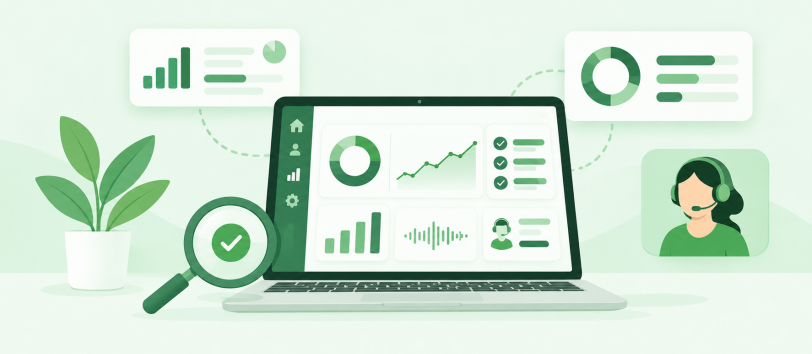
The biggest change is in customer behavior. Many people now try to solve a problem with a general AI tool before they ever contact the brand. Gartner's 2026 customer research found that customers are about three times more likely to use third-party generative AI tools than a company's own chatbot. So when a ticket reaches your support queue, it is often the customer's second or third attempt, and they have usually been given a partial or wrong answer along the way.
That has a practical effect on training. If agents are taught to treat every inquiry as a fresh start, they will ask questions the customer has already answered and repeat advice the customer has already tried. Agents in outsourced teams need to ask early what the customer has already done, spot where the outside answer went wrong, and correct it without making the person start over.
AI adoption inside service teams has also moved fast. Salesforce's 2026 survey of service professionals reported that AI agent adoption rose from 39% in 2025 to 66% in 2026, and 70% of adopters saw measurable value within 60 days. As a result, buyers now separate providers that have built AI into daily delivery from those that still sell seats by the hour.
The AI-to-Human Handoff Is Now the Quality Test
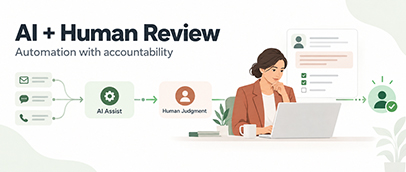
Older quality programs scored agents on handle time, script adherence and CSAT. Those numbers still matter, but they no longer tell you much about a hybrid operation. What tells you more is what happens at the moment an AI agent gives up and a person takes over. Gartner reports that 85% of service leaders are expanding the responsibilities of human agents rather than shrinking them, which means the human side of the handoff is becoming more skilled, not less.
Three questions expose most weak spots. Does the customer's history travel with the ticket, or does the customer have to explain again? Can the human agent see what the AI already tried? And is there a record of why the AI failed, so the same failure can be fixed rather than repeated? Good providers treat the escalation path as something they design and measure, not something left to chance.
The table below sets out what to look for.
| Evaluation area | What a mature AI-enabled provider shows | What a legacy provider often shows |
|---|
| Escalation design | Documented handoff with context carried over and a record of failure types | Manual transfer with no view of the earlier AI conversation |
| Automation scope | Resolution rate by interaction type, with the measurement method explained | General claims of "AI-powered" with no operating numbers |
| Agent support | Live AI suggestions on complex cases, with escalation triggers in the agent desktop | Fixed scripts and manual lookup |
| Channel continuity | One customer view across voice, chat, email and social | Separate teams and tools for each channel |
| Security | SOC 2 Type II or ISO 27001 covering the actual delivery center, plus documented AI data rules | Certificates held only at the parent company |
Which Interactions to Outsource and Which to Keep
Most guides skip this question, yet it shapes the whole contract. A workable rule is to sort your volume by two things: how predictable the resolution is, and how much the interaction depends on knowledge only your own staff hold.
High-volume, well-documented interactions such as order status, returns, account access, and basic product questions are the natural fit for an outside team, because they benefit most from scale, extended hours and language coverage. Interactions that involve contract negotiation, safety-critical judgment, or unreleased product details are usually better kept in house, or handled by a small dedicated team under stricter controls. Everything in the middle, such as billing disputes or technical troubleshooting, is where a pilot pays for itself, since you can watch how the provider performs before deciding.
Consider a consumer electronics brand that launches a new product line in three countries. Order and shipping questions triple in the first two weeks, while a small share of tickets involve a hardware defect that needs engineering input. Outsourcing the first group to a multilingual team frees the internal staff to work on the second. Trying to hire fast enough for the launch peak, then letting people go afterward, is the expensive alternative.
Why Building In-House Costs More Than It Looks
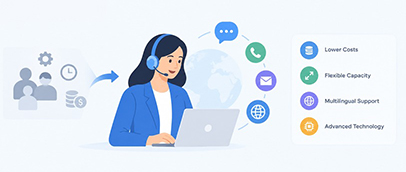
A spreadsheet comparison of in-house and outsourced support often understates the in-house side. Recruiting, product training, tooling, attrition, and coverage across time zones and languages each add ongoing cost, and they compound. Outsourcing turns much of that fixed cost into variable cost, and many companies report total savings of 30–40% after the transition.
Flexibility matters as much as the saving. A launch, a seasonal peak or an incident can double inbound volume in a few days. An internal team can only respond by over-hiring in advance. A provider whose processes are built for swings in demand can add capacity without a drop in quality.
Language coverage is another gap. Supporting ten or fifteen languages with native-level agents, who understand local expressions and expectations, is a large staffing project for a single company. Attempts usually end with strong support in the home market and slower, weaker support elsewhere, and customers notice. Professional providers keep multilingual teams as a permanent part of their service.
For most companies, then, the question in 2026 is less "how do we save money" and more "how quickly can we get infrastructure, coverage and AI tooling that would take years to build ourselves."
How Nexlence Approaches Customer Support Outsourcing
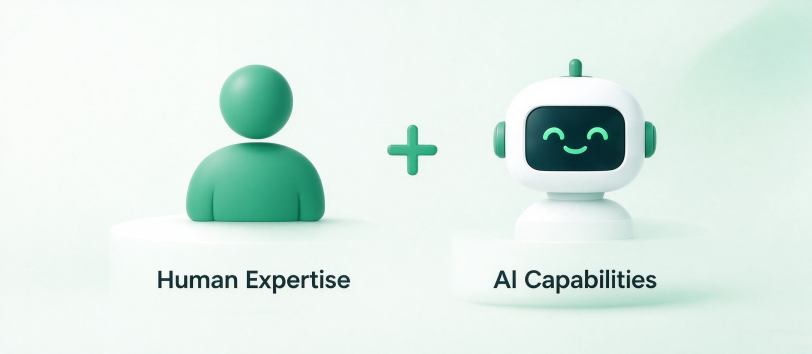
Nexlence is an AI-powered customer experience partner for global brands. Its X-Force platform coordinates AI agents, knowledge management and real-time risk monitoring, and a network of more than 5,000 professionals in several global centers handles the cases that need human judgment. Routine requests are resolved by AI at scale, and complex escalations go to trained specialists under agreed rules.
The company focuses on brands whose customers are Gen Z, in sectors such as e-commerce, consumer goods, smart manufacturing and media, where volume rises and falls quickly, customers speak many languages, and inconsistent answers are costly. Two examples show the range. A cross-border e-commerce platform was supported across more than 15 cities and kept a leading position in supplier satisfaction. A pharmaceutical program handled over one million service interactions with CSAT above 95%.
For clients, the working arrangement is the same in both cases: performance reporting that can be audited, KPIs owned jointly, and ramp plans tied to agent proficiency milestones rather than calendar dates.
Related guide: Call Center BPO Services: A Guide to Choosing the Right Customer Support Partner
FAQ
How can we judge a provider's AI capability without getting lost in demos?
Ask for the resolution rate by interaction type instead of a product walkthrough. Three questions do most of the work: what share of your current volume does the automation resolve without a person, how is a failure detected and escalated, and what happens to the customer's context during the handoff. A provider who cannot answer these in operating terms is showing technology, not capability. Measurable value depends on how the escalation path is built, much more than on which platform is used.
What security and compliance questions should we ask before signing?
Ask for the current SOC 2 Type II report or ISO 27001 certificate, and check that its scope names the delivery center that will handle your program. Then confirm how your customer data is separated from other clients, what the retention and deletion rules are, and whether AI models are trained on your interaction data. If GDPR, CCPA or an industry regime applies to you, the provider should be able to map its data flows to your obligations without leaning on the parent company's certificates.
How long should a pilot run before a long-term contract?
Four to six weeks is usually enough, provided the pilot includes at least 20% complex or escalated interactions and some that the provider did not see during the sales process. Score them against your own quality standards. If routine work goes well but complex cases fall short, look into that gap before you widen the scope.
Does outcome-based pricing work for every type of interaction?
No. It works when success is clearly defined and volume is high enough to give reliable numbers. For complex, low-volume or compliance-sensitive work, a dedicated-agent model with performance guarantees is often safer. Many buyers end up with a mix, applying different commercial terms to different interaction types and defining clearly when a case moves from one to the other.
Conclusion
Outsourcing customer support in 2026 comes down to a few concrete choices. Decide which interactions are predictable enough to hand over and which need to stay close to your own teams. Test how a provider manages the moment an AI agent passes a customer to a person, because that moment shows the quality of the whole operation. And check that the delivery model can absorb a spike in volume or a new language without a drop in service. A short, well-designed pilot is the most reliable way to answer all three before you commit.
Sources
Gartner, Customer Insights 2026: Align GenAI Investments With New Customer Behaviors (survey of 3,566 B2B and B2C customers, February–March 2026)
Salesforce, Customer Service AI Agent Edition (survey of 3,075 service professionals across 13 countries, 2026)














 Nexlence




 PREVOUS ARTICLE