Quick Answer
A strong direct to consumer customer experience helps turn first-time buyers into repeat customers. For DTC brands, the biggest opportunities often come after the first purchase: making delivery clear, resolving problems quickly, simplifying returns, providing useful product support, and giving customers relevant reasons to come back.
In 2026, brands should connect customer experience with measurable business results such as repeat purchase rate, purchase frequency, average order value, and customer lifetime value.
What Is Direct to Consumer Customer Experience?
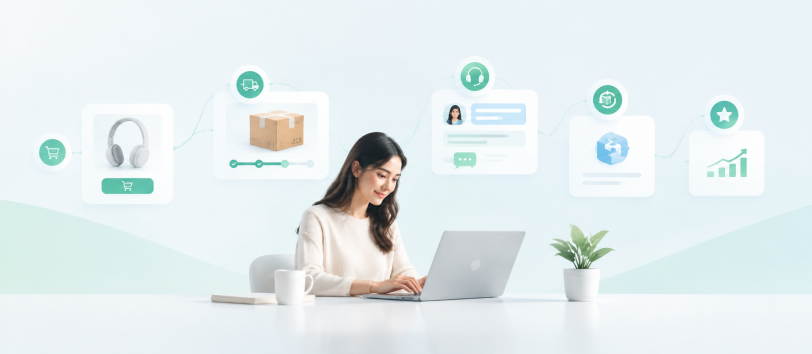
Direct-to-consumer (DTC) brands sell directly to customers through channels such as their own websites, apps, social media, and online stores.
Because there is no retailer between the brand and the customer, the company controls more of the customer relationship. That includes product information, checkout, delivery communication, customer service, returns, and follow-up communication.
This creates an opportunity, but also a challenge. A customer may enjoy the shopping experience but become frustrated by slow support or a difficult return. From the customer's perspective, all of these interactions belong to the same brand.
That is why direct to consumer customer experience should cover the full relationship, not just the checkout page.
Why Does Customer Experience Matter for DTC LTV?
Customer lifetime value (LTV) estimates how much revenue a customer can generate during the relationship with a brand.
For DTC companies, LTV is closely connected to a few basic behaviors:
How often customers buy
How much they spend per order
How soon they make another purchase
How long they remain customers
A better customer experience can support these behaviors by making customers more confident in buying again.
For example, a customer who receives helpful product guidance after purchase may have fewer problems using the product. A customer who can complete a return easily may be more willing to order from the same brand again.
Shopify's recent ecommerce research recommends looking at repeat purchase rate, purchase frequency, AOV, LTV, and churn together when measuring customer retention.
7 Strategies to Improve DTC Customer Experience and LTV
1. Focus on What Happens After the First Purchase
The first order is only the beginning of the customer relationship.
After purchasing, customers may want to know when their order will arrive, how to use the product, what to do if something goes wrong, or how to request a return.
DTC brands should make these steps easy to understand.
For example, a consumer electronics brand can provide simple setup instructions after delivery. A skincare company can explain how to use a new product. A subscription business can clearly explain renewal and delivery dates.
Small improvements at this stage can reduce confusion and give customers more confidence in the brand.
2. Make Customer Service Part of Retention
Customer service should not only focus on answering questions quickly.
The more important question is whether the customer's problem was actually solved.
A customer who contacts support three times for the same problem is having a poor experience even if every response was technically fast.
Useful service metrics include first-contact resolution, repeat contact rate, response time, and customer satisfaction.
For DTC brands, these metrics should also be compared with repeat purchase behavior.
If customers who receive fast and effective support are more likely to purchase again, customer service is contributing directly to retention.
3. Make Returns and Exchanges Simple
Returns are one of the moments when customers test how easy a brand is to deal with.
The process should clearly explain what customers need to do, how long the process takes, and when they can expect a refund or replacement.
A difficult return can turn a product problem into a brand problem.
A simple return process does not mean accepting every request. It means giving customers clear rules and avoiding unnecessary steps.
For DTC brands, this can be especially important because customers may have many competing brands available online.
4. Use Customer Data to Make Interactions More Relevant
DTC brands have access to useful customer information, including purchase history, previous support contacts, product preferences, and buying frequency.
This information can make customer communication more useful.
A customer who bought a product yesterday may need usage instructions. A customer who normally reorders every three months may need a reminder around that time. Someone who recently contacted support may need follow-up help rather than another promotional message.
McKinsey's research on AI-powered customer experiences highlights the use of customer data and AI to identify relevant next actions throughout the customer relationship.
Good personalization is not about sending more messages. It is about sending something useful at the right time.
5. Turn Customer Questions Into Business Insights
Customer service teams hear problems that other departments may never see.
If many customers ask the same product question, the product page may not contain enough information.
If customers repeatedly ask where their orders are, delivery communication may need improvement.
If many customers return a product for the same reason, the company may need to review its product description, sizing information, packaging, or instructions.
DTC brands can use these patterns to improve the wider customer experience.
This also helps reduce future support volume because the company addresses the cause instead of repeatedly answering the same question.
6. Give Different Customers Different Experiences
A first-time buyer does not have the same needs as a loyal customer.
New customers may need more product information and reassurance. Repeat customers may want faster purchasing and easier access to their preferred products.
Brands can use customer groups to understand these differences.
| Customer Group | Common Need | CX Focus |
|---|
| First-time buyer | Product confidence | Clear information and onboarding |
| Recent buyer | Order reassurance | Delivery and post-purchase support |
| Repeat buyer | Convenience | Easy reordering |
| High-value customer | Recognition | Personalized service |
| Inactive customer | Reason to return | Relevant re-engagement |
This is usually more effective than sending exactly the same customer communication to everyone.
7. Use AI to Support People, Not Complicate the Experience

AI can handle many repetitive customer service tasks.
It can identify the type of inquiry, find relevant information, summarize previous conversations, and help agents respond faster.
But not every situation should be automated.
A simple order-status question may be handled automatically. A complicated complaint or unusual refund request may need a human employee.
| Customer Need | AI Can Help With | Human Support |
|---|
| Order status | Retrieve information | Handle exceptions |
| Product questions | Find relevant information | Explain unusual situations |
| Return requests | Check standard rules | Handle exceptions |
| Complaints | Summarize the issue | Decide the resolution |
| Customer feedback | Identify common themes | Decide what action to take |
The goal is to reduce unnecessary work while keeping human support available when customers actually need it.
How Should DTC Brands Measure CX and LTV?
Customer satisfaction is useful, but it should not be the only measurement.
A DTC brand should also look at what customers do after an interaction.
| Metric | What It Shows |
|---|
| Repeat purchase rate | How many customers buy again |
| Time to second purchase | How quickly customers return |
| Purchase frequency | How often customers buy |
| Average order value | How much customers spend per order |
| LTV | Long-term customer value |
| Churn | How many customers stop buying |
| Repeat contact rate | Whether problems are being resolved |
Looking at these metrics together gives a clearer picture.
For example, if customer satisfaction increases but repeat purchases do not, the CX improvement may not be affecting customer behavior. If repeat purchases increase after improving post-purchase support, the change may be contributing to retention.
Where Outsourced CX Fits Into DTC Growth
As DTC brands grow, customer operations can become difficult to manage internally.
More orders mean more customer questions. International expansion creates multilingual requirements. Social commerce adds new customer conversations. Product launches can create sudden increases in support volume.
An external CX partner can provide additional capacity for customer service, social support, digital interactions, and multilingual operations.
Nexlence combines customer service operations with digital CX capabilities, AI-supported workflows, and human expertise. This can help DTC brands manage growing customer interaction volumes while keeping product decisions, brand policies, and other strategic responsibilities in-house.
For companies expanding across markets, this type of model can also provide access to customer operations without building a separate support structure for every market.
Related guide: Customer Experience Solutions Demystified: What They Are, Why They Matter, and How to Choose the Right One
How Nexlence Supports DTC Customer Experience
Nexlence provides customer experience operations across digital and customer service channels.
Its approach combines AI-supported workflows with human customer service, allowing routine interactions to be handled efficiently while more complex customer situations can receive human attention.
For DTC brands, this can support areas such as customer service, digital customer experience, social customer care, and multilingual operations.
The goal is straightforward: help brands maintain consistent customer support as their customer base, markets, and interaction volume grow.
Final Takeaway
A successful direct to consumer customer experience is not about adding more customer touchpoints.
It is about making the relationship easier at the moments that matter.
Clear post-purchase communication, useful customer service, simple returns, relevant personalization, better use of customer feedback, appropriate customer segmentation, and practical AI support can all contribute to a stronger customer relationship.
DTC brands should then connect these improvements with business metrics such as repeat purchases, purchase frequency, AOV, retention, and LTV.
When customers find it easy to buy, use, return, and get help with a product, they have fewer reasons to leave—and more reasons to buy again.
FAQ
What is direct to consumer customer experience?
It is the complete customer experience a DTC brand provides across its website, ecommerce store, customer service, social channels, delivery, returns, and post-purchase interactions.
How does customer experience affect LTV?
A better experience can encourage customers to buy again, purchase more frequently, and remain customers for longer. These behaviors can increase customer lifetime value.
What are the most important DTC CX metrics?
Repeat purchase rate, time to second purchase, purchase frequency, AOV, LTV, churn, customer satisfaction, and repeat contact rate are useful metrics to monitor.
Can AI improve DTC customer experience?
Yes. AI can help with routine questions, customer classification, information retrieval, conversation summaries, and agent assistance. Human support remains important for complex complaints and unusual situations.
Should DTC brands outsource customer service?
Outsourcing can make sense when customer volume, international expansion, multilingual requirements, or additional digital channels make internal operations difficult to scale.
Sources
Shopify, “Direct to Consumer (DTC): How the Model Works.”
Shopify, “How to Improve Ecommerce Customer Retention.”
McKinsey & Company, “Next best experience: How AI can power every customer interaction.”
Qualtrics XM Institute, “Consumer Satisfaction and Loyalty, 2025.”















 Nexlence





 PREVOUS ARTICLE