We use cookies to improve our site. By using or further navigating our site you accept our cookie policy.Please click here to check the Privacy Policy and Cookie Policy.



Smart
Empowerment

2026-10-10
 Nexlence
Quick Answer: Choosing the right customer experience solution provider is less about finding the provider with the longest service list and more about determining whether its operating model fits your customer experience requirements. Businesses should examine how a provider handles customer data, complex interactions, escalation, quality control, AI-assisted workflows, human decision-making, reporting, and accountability before comparing commercial terms.
Choosing among customer experience solution providers can be difficult because many providers appear similar during the initial evaluation. Most can discuss omnichannel support, AI, analytics, customer service operations, and multilingual delivery. The differences become much clearer when a business examines what happens inside the actual customer workflow. For companies considering customer service outsourcing services, the more useful question is therefore not simply “What services does this provider offer?” but “How will this provider make decisions, handle exceptions, and give us visibility into the customer experience?”
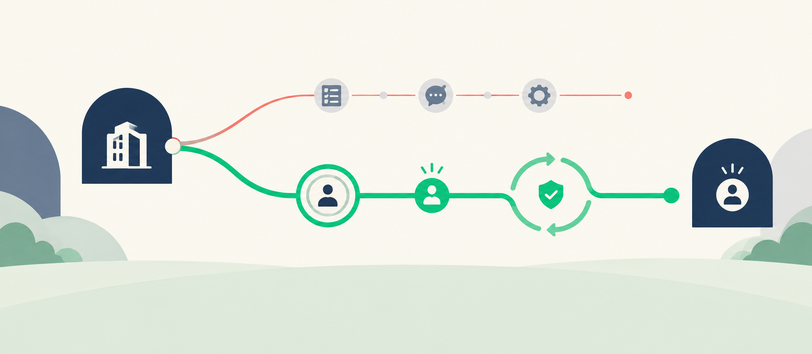
A conventional vendor comparison often starts with a spreadsheet.
One column contains channels. Another lists languages. Another covers AI, analytics, CRM integration, quality assurance, and reporting. Each provider receives a check mark if it claims to offer the capability.
The problem is that a check mark does not tell you how the capability works.
Two providers may both advertise AI-powered customer service while using AI in completely different ways. One may use it primarily for automated responses. Another may use AI to classify interactions, retrieve information, assist agents, analyze conversations, and identify operational patterns.
Likewise, two providers may both offer omnichannel support while maintaining very different levels of customer context between channels.
This is why provider selection should move from a capability comparison to an operating-model comparison.
The key question is not whether a provider has a particular feature. It is how that feature changes the way customer interactions are handled.

Before comparing vendors, clarify the boundary between your internal team and the external provider.
This is often more important than the provider's individual technology capabilities.
A business may want an external partner to manage customer inquiries while keeping product decisions, refunds, policy exceptions, and sensitive escalations internally. Another company may want the partner to take responsibility for a much broader customer operations workflow.
Neither model is inherently better. The problem occurs when responsibilities are unclear.
A provider should be able to explain exactly where its responsibility begins and ends.
For example, consider a customer interaction involving a complaint. The provider may be responsible for identifying the issue, gathering the customer's history, checking relevant policies, and preparing the case for escalation. The business may retain responsibility for approving an exception.
That distinction should be visible in the operating model rather than left to individual agents to interpret.
A useful evaluation therefore asks:
| Question | What You Need to Understand |
|---|---|
| What does the provider own? | The customer interactions and operational tasks it will directly manage |
| What remains internal? | Decisions requiring company authority or specialized knowledge |
| Where are escalation points? | The conditions that require another team or decision-maker |
| Who owns customer data? | Data access, governance, and responsibility |
| Who controls quality standards? | How service quality is defined and reviewed |
| Who acts on performance insights? | Whether reporting leads to operational changes |
This creates a much more realistic picture of the relationship than a list of outsourced functions.
Routine interactions are not necessarily the best way to evaluate a customer experience solution provider.
Most vendors can demonstrate how they handle straightforward requests.
The more revealing question is what happens when the normal process stops working.
A customer may provide incomplete information. A policy may not clearly cover the situation. Two previous interactions may contain conflicting information. A customer may dispute the response provided by the first agent. An issue may require coordination between customer service and another business function.
These situations expose the quality of the provider's operating model.
A mature provider should have a defined mechanism for identifying exceptions, collecting the relevant context, escalating the case, and maintaining ownership until the next action is clear.
This is also where the relationship between AI and human expertise becomes important.
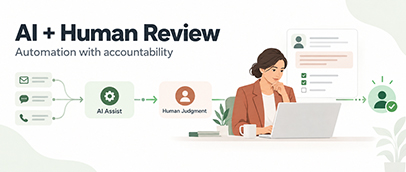
AI may be able to identify the topic, summarize the interaction, retrieve relevant information, and flag inconsistencies. A human specialist may still need to determine the appropriate action.
The important issue is therefore not whether the provider uses AI, but whether the provider has designed a sensible decision path around AI.
“Omnichannel” has become a common term in CX marketing.
But having multiple channels does not necessarily mean customers experience those channels as one connected journey.
A business should investigate what happens to customer context when an interaction moves from one channel to another.
Can the next agent see previous conversations?
Can the system distinguish between a new question and an unresolved issue?
Can customer history influence routing or prioritization?
Can the provider identify repeated contacts about the same underlying problem?
These questions matter because customers generally experience the company as one organization, even when different teams or platforms handle individual interactions.
The operational architecture behind the channels therefore deserves more attention than the number of channels listed in a proposal.
Customer data is one of the most overlooked parts of CX provider evaluation.
A provider may collect enormous amounts of interaction data, but the business needs to understand what happens to that information afterward.
Does the data remain available for analysis?
Can recurring customer problems be identified?
Can interaction history be connected to customer records?
Can quality teams use conversation data to identify patterns?
Can management distinguish an isolated complaint from a broader issue?
This is where customer experience management becomes different from simply operating a customer contact function.
The interaction itself is only one source of information. The accumulated data can reveal where customers encounter friction, where policies create confusion, and where service processes repeatedly fail.
A provider that can turn interaction data into operational insight can potentially contribute more value than one that simply manages a higher volume of contacts.
AI should be assessed according to the work it performs.
A provider may describe its platform as AI-powered, but procurement teams should ask more precise questions.
What decisions can AI make?
What information can it retrieve?
Can it summarize previous interactions?
Can it identify intent?
Can it support agents during live conversations?
Can it review interactions after completion?
Can it identify unusual patterns?
Most importantly, what happens when AI is uncertain?
This last question is particularly important.
A reliable CX workflow should not assume that every customer interaction can be handled automatically. AI may perform well for a clearly defined task while still requiring human intervention when the interaction becomes ambiguous or sensitive.
A useful provider should therefore be able to explain not only its automation capabilities but also its human escalation logic.

Quality assurance is another area where provider proposals can look stronger than the underlying operation.
Ask how quality is measured, but also ask who reviews the results and what happens afterward.
For example, finding that a particular interaction failed to meet a quality requirement is only the beginning. The provider should have a process for identifying why the issue occurred and whether it represents an individual error or a broader operational problem.
This distinction matters.
If the same type of error appears across multiple interactions, the solution may not be additional agent training. The underlying knowledge base, workflow, policy interpretation, or system configuration may need to change.
AI can make this analysis more scalable by reviewing larger volumes of customer interactions, but human oversight remains important when determining what operational changes should follow.
Rather than asking providers to give another presentation of their capabilities, give them a realistic customer-operation scenario and ask them to walk through it.
The scenario should contain enough complexity to expose the provider's decision-making process.
For instance, a customer has contacted the business several times through different channels. The latest interaction contradicts information from an earlier conversation. The customer is now requesting an exception that is outside the standard policy.
Ask the provider to explain:
| Evaluation Point | What to Look For |
|---|---|
| Customer identification | How the previous interactions are connected |
| Context retrieval | How relevant information is surfaced |
| Intent recognition | How the underlying issue is identified |
| AI involvement | Which tasks AI performs |
| Human involvement | Where human judgment enters |
| Escalation | How the exception is transferred |
| Accountability | Who remains responsible for the case |
| Reporting | How the interaction becomes measurable data |
This kind of exercise often reveals differences that are invisible in standard vendor presentations.
It also gives the procurement team evidence about how the provider thinks, rather than simply what it claims to offer.
Once the evaluation moves beyond feature lists, the comparison becomes more meaningful.
| Evaluation Dimension | Questions to Ask |
|---|---|
| Operating model | Does the provider's workflow match our responsibilities and decision structure? |
| Customer context | Can agents access the information required to understand the interaction? |
| AI workflow | Is AI used for specific tasks with appropriate human oversight? |
| Exception handling | What happens when a case falls outside the normal process? |
| Quality management | How are problems identified, investigated, and corrected? |
| Data utilization | Can interaction data generate useful operational insights? |
| Integration | Can the provider work with the systems already used by the business? |
| Governance | Are ownership, access, escalation, and accountability clearly defined? |
| Reporting | Does reporting explain customer outcomes as well as operational activity? |
| Adaptability | Can workflows change when products, policies, or customer expectations change? |
The purpose of this framework is not to produce a universal score.
Different businesses will place different importance on each dimension. A highly regulated organization may prioritize governance and escalation controls, while an international consumer brand may place greater emphasis on multilingual operations and cross-channel customer context.
The provider should fit the business rather than the other way around.
Before signing an agreement, the evaluation should become increasingly specific.
Ask the provider to show how a customer interaction moves through its operation rather than simply describing its service offering.
Ask where customer information is stored, who can access it, how AI interacts with that information, and what happens when an AI-generated recommendation is incorrect.
Ask how quality issues are detected and how quickly operational changes can be introduced.
It is also useful to ask what the provider considers outside its responsibility. A clear answer can be more valuable than a provider claiming to handle everything.
Finally, examine how performance discussions will work after implementation. The relationship should have a mechanism for reviewing results, identifying recurring problems, and adjusting workflows when customer requirements change.
Nexlence approaches customer experience through a combination of AI-driven technology and human customer operations rather than treating technology and service delivery as separate functions.
Its digital CX capabilities connect omnichannel customer interactions with AI, real-time data insights, quality management, and human operations. The model is designed to support customer-facing workflows across digital touchpoints while maintaining human involvement where judgment and operational ownership are required.
For businesses evaluating customer service outsourcing services, this approach is relevant when the requirement extends beyond adding external customer service capacity and includes the management, analysis, and improvement of customer interactions.
Look beyond the provider's service catalog. Examine its operating model, customer-data handling, integration capabilities, AI workflow, human escalation process, quality management, reporting, governance, and ability to adapt to your specific customer operations.
Give each provider the same operational requirements and scenario-based questions. Comparing how each provider handles customer context, exceptions, escalation, AI involvement, quality control, and reporting can reveal differences that standard feature comparisons miss.
AI is increasingly relevant, but its presence alone should not determine the decision. Businesses should evaluate what AI actually does within the customer workflow and whether the provider has appropriate human oversight and escalation mechanisms.
The distinction varies by provider. Traditional customer service outsourcing may focus primarily on managing defined customer interactions, while a broader CX provider may combine customer operations with digital channels, AI, analytics, quality management, and customer-experience intelligence.
Integration can significantly affect the quality of customer operations because agents and AI systems often need access to customer history, knowledge, transaction information, and other operational data. Businesses should evaluate specific integration requirements rather than accepting a general claim of “seamless integration.”
Price should be evaluated alongside operational scope, quality requirements, technology, governance, and expected outcomes. A lower quoted cost may not represent a lower overall cost if the operating model creates additional management effort or unresolved customer issues.
The strongest way to evaluate customer experience solution providers is to stop comparing them only by what they sell and start examining how they operate.
A provider's real capabilities become visible when a customer interaction becomes complicated: when information is incomplete, when previous interactions matter, when AI needs human oversight, or when a routine issue reveals a broader operational problem.
That is where businesses can determine whether a provider is simply supplying customer-service capacity or can genuinely become part of a broader customer experience operation.
For companies exploring external CX support, customer service outsourcing services can provide the operational foundation, while AI, customer data, quality management, and human expertise can extend that foundation into a more connected customer experience model.
Related guide: How to Scale Omnichannel Customer Support: A Strategic Guide for 2026
Salesforce, State of Service — Seventh Edition, research examining the changing role of AI, data, and service organizations. Salesforce State of Service
Qualtrics XM Institute, The State of Customer Experience Management, 2025, covering CX management practices, organizational challenges, and technology adoption. Qualtrics XM Institute
McKinsey & Company, The economic potential of generative AI: The next productivity frontier, discussing the potential impact of generative AI across customer operations and other business functions. McKinsey















 PREVOUS ARTICLE
